
Home Electrical Safety Inspection: What It Covers
U.S. local fire departments responded to an estimated annual average of 46,652 home structure fires a year from 2020 to 2024 in which an electrical failure or malfunction contributed, or electrical distribution, lighting, or power-transfer equipment was involved, according to the National Fire Protection Association. Those fires caused about 527 civilian deaths, 1,580 civilian injuries, and $2.4 billion in direct property damage each year. They were about 13% of home structure fires, yet 18% of home fire deaths and about 15% of direct property damage. 15% began in kitchens or cooking areas, 12% in bedrooms, and 9% in attics or ceilings.
A home electrical safety inspection is how you look for those hazards while the house is quiet. It is a planned review of what a licensed electrician can see and test. It is not the visit you want when an outlet is already hot or a breaker will not stay on.
Table of Contents
What a Home Electrical Inspection Covers
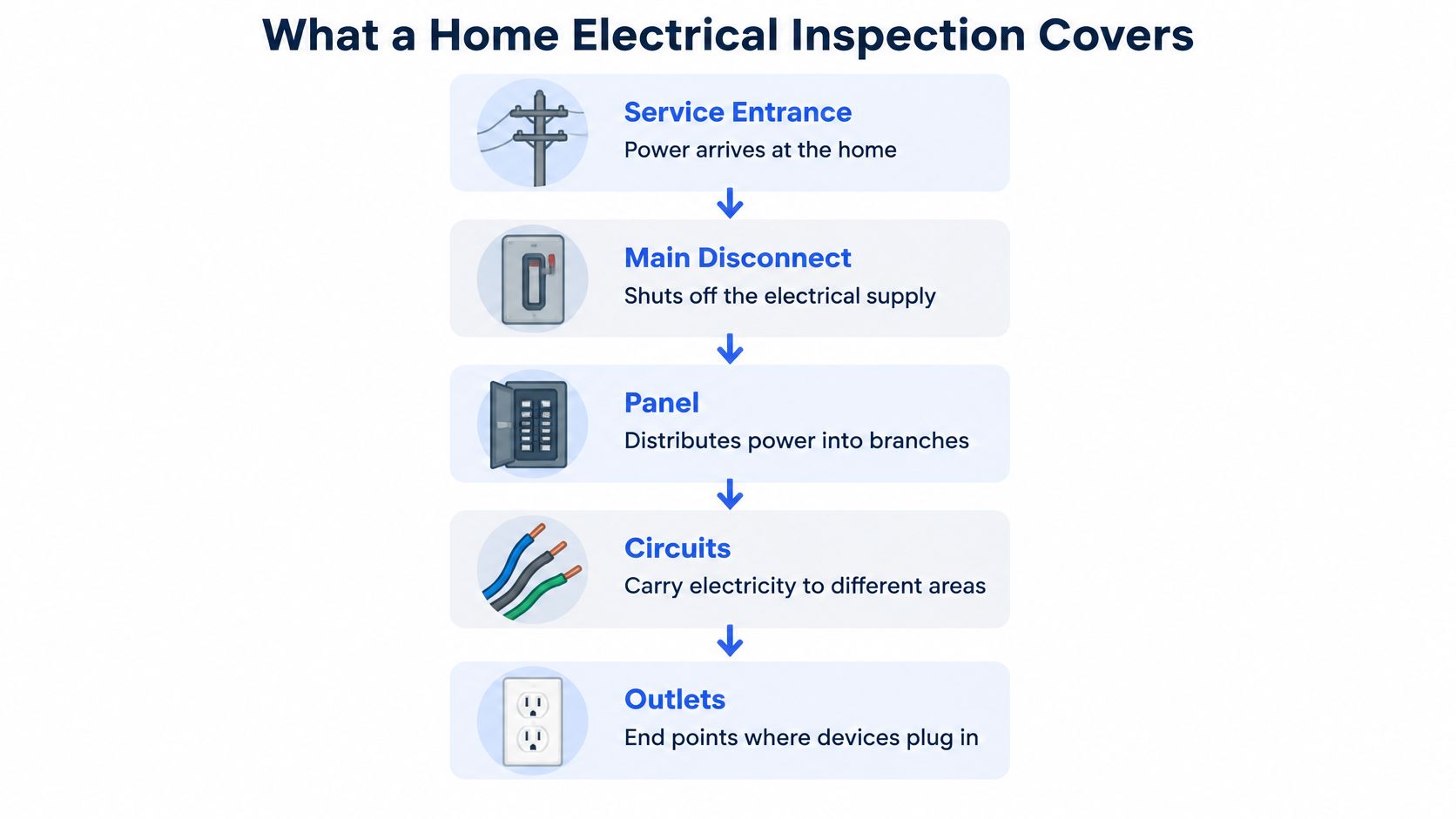
Power moves as one path. It arrives at the service entrance, passes the main disconnect, splits inside the panel, travels on branch circuits, and ends at outlets, switches, and lights. A fault at the last device is still a fault in that path.
Treat the panel as the heart and each outlet as a fingertip. A warm plate in a bedroom is not a small local nuisance. It is the same system that feeds the kitchen and the attic.
An inspection that stops at the panel misses the rooms where many of these fires start. The electrical safety guidance for Sebring homeowners from ClimateGuard Cooling Services is a clear companion if you want a plain walk-through of why room-level checks matter before you book.
Area by area
Component | What the Inspector Checks | Warning Sign Found |
|---|---|---|
Service entrance and meter | Condition of cables, weatherhead and meter base, signs of heat or corrosion | Scorched or discolored connections |
Main disconnect and panel | Labeling, cover, clearances, panel brand and overall condition | Missing labels, rust, burn marks |
Breakers and fuses | Correct size for each wire, secure fit, trip function | Breakers that run warm or will not reset |
Branch wiring | Insulation type and condition, routing, damage from nails or rodents | Brittle, cracked or softened insulation |
Connections and grounding | Tight terminations, grounding and bonding conductors | Loose wire connections, missing ground |
Outlets and switches | Secure mounting, GFCI and AFCI protection where required, signs of heat | Warm faceplates, scorched receptacle faces |
Lighting fixtures | Fixture rating for bulb and enclosure, wire connections | Fixtures warm to the touch, buzzing |
Overload evidence | Extension cords used as permanent wiring, daisy-chained power strips | Melted plugs, sticky or discolored outlets |
The inspector is looking for heat, loose metal, damaged insulation, and protection that is missing where water or sleeping rooms need it. A clean cover does not prove the terminations behind it are tight.
Before you book, spend five minutes. Read the panel door label. Feel a few outlet plates, and unplug anything on a plate that is warm. Note any extension cord that lives under a rug. Count wet-area outlets with no GFCI test and reset buttons. That list is the start of the scope.
When a Routine Inspection Is Due
Timing follows risk, not a birthday on the calendar. U.S. Consumer Product Safety Commission guidance states that homes 40 years old or more are overdue for an electrical inspection. For homes roughly 10 to 40 years old, an inspection is advisable when substantial loads have been added, such as high-wattage appliances, lighting, receptacles, or heavy extension-cord use, or when warning signs show up. Those signs include frequent fuse blowing or breaker tripping, flickering lights, and receptacle or switch plates that become hot.
Practical rule: A breaker that has never tripped does not prove a connection is safe. A loose or corroded termination can heat the wire while the current stays below the trip point.
Repeated trips can reflect overload, a short, worn insulation, or a high-resistance joint. That joint can damage the conductor and the box long before the breaker opens. The visit should include a look at service equipment, insulation, terminations, grounding and bonding, receptacles, and signs of overheating, then targeted testing where something looks wrong.
Match your house to a row
Home Situation | Inspection Advice | Why It Matters |
|---|---|---|
Built 40 or more years ago | Overdue; schedule a full inspection | Insulation and connections age and can degrade |
Built 10 to 40 years ago, no changes | Inspect if warning signs appear | Lower routine need, but symptoms still matter |
Built 10 to 40 years ago with new heavy loads | Advisable | Added appliances and circuits push wiring beyond its original use |
Frequent extension-cord use or added receptacles | Advisable | Cords used as permanent wiring signal missing outlets |
Recent renovation or new wiring | Inspect once work is finished | Confirms the workmanship behind the new circuits |
Buying a home with no electrical records | Inspect before or soon after purchase | The wiring history is unknown |
Any home with repeated trips, flicker or warm plates | Inspect now | These symptoms can point to an active fault |
Say the kitchen gained a dishwasher and a microwave on the old small-appliance circuit. That house sits in the new-load row even if the panel looks tidy. A buyer with no permits and no prior report sits in the unknown-history row.
Find the build year on the listing, the assessor card, or the panel date if one is stamped. List every change since, including DIY outlets. Match the row that fits, and book from that row rather than from a round number of years.
Live Symptoms That Need Action First
A warm outlet is not a reminder to "get an inspection someday." A routine visit is a planned, mostly visual and test-based review. A live symptom can mean a fault that is still heating or arcing. Hyre Electrical treats that kind of symptom as a reason a general inspection can be the wrong next step, because waiting can raise the risk.
Checklists love panel labels, grounding, and protective devices. They rarely say what to do in the next ten minutes. Stop using the affected circuit. Don't open the panel or any device. Call for a prompt diagnosis instead of a calendar slot weeks out.
Symptom triage
Symptom | Do This First | Response Level |
|---|---|---|
Burning smell near an outlet or panel | Turn off the circuit if you can do so safely, stop using it, do not open equipment | Urgent; call an electrician now |
Warm outlet, switch plate or cord | Unplug the device, stop using the outlet | Urgent |
Breaker will not reset | Leave it off and do not force it | Urgent |
Sparking, buzzing or crackling | Stay clear of the source and stop using the circuit | Urgent; call emergency services if there is fire or smoke |
Breaker trips again after one reset | Reduce the load on that circuit and stop repeated resets | Prompt diagnosis |
Frequent blown fuses | Note what was running and avoid replacing with a larger fuse | Prompt diagnosis |
Flickering lights | Note which lights flicker and whether other large loads start | Prompt diagnosis |
Fire or smoke present | Leave the home and call the fire service | Emergency |
In 2024, the Electrical Safety Foundation survey of electrical contractors found that 54% of service calls involved tripped breakers or fuses. A repeat trip is a symptom to report, not a reset to keep trying. For lights that dip when a motor starts, our note on how to fix flickering lights separates a loose bulb from a supply problem. Either way, write down what you saw before anyone arrives.
Don't open equipment, don't force a breaker, don't swap in a larger fuse, and don't keep resetting a breaker that trips again.
Hand the electrician four facts: date and time, room or device, what was running, and whether it repeats. An inspection can't certify wiring it can't reach. Ask for a written scope that names the receptacles, circuits, and protective devices that were tested, and what was left out.
GFCI and AFCI Protection Checks
A complete check covers shock protection and fire protection. Power at the receptacle is not the same thing as a safe circuit.
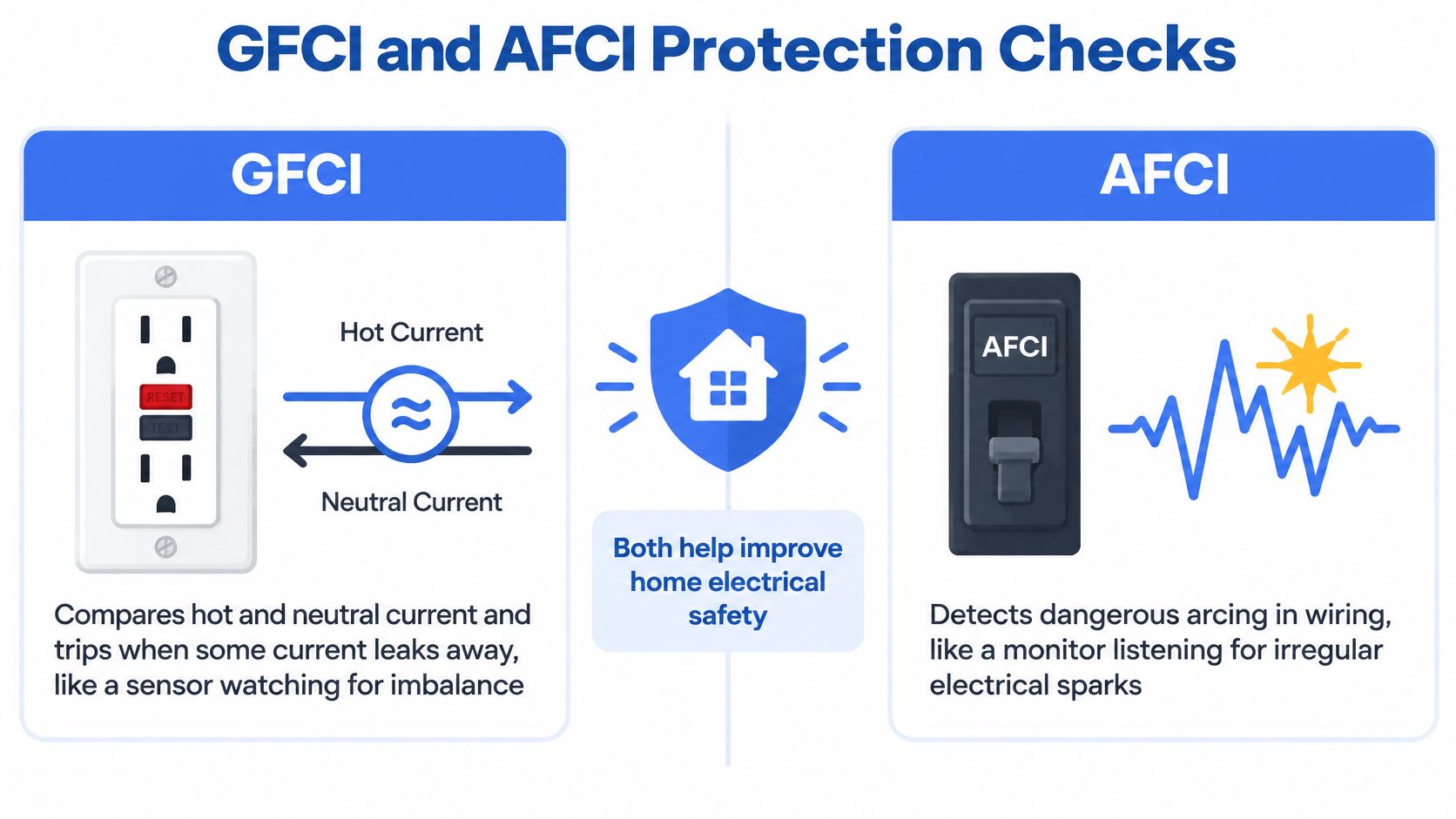
A GFCI compares current leaving on the hot wire with current returning on the neutral. If some current leaks toward ground, including through a person, the device opens the circuit. Think of it as a sensor watching for imbalance. An AFCI watches the waveform for the jagged pattern of dangerous arcing. An ordinary breaker often misses that pattern until insulation is already burning. Think of the AFCI as a monitor listening for irregular sparks in the wire.
Side by side
Device | Protects Against | Typically Required In | Test Routine |
|---|---|---|---|
GFCI | Shock from current leaking to ground | Kitchens, bathrooms, laundry areas, garages and outdoor outlets, as local code specifies | Press test, confirm trip, press reset; monthly |
AFCI | Hazardous arcing in wiring that can start fires | Bedrooms, living areas and other circuits the local code lists | Press test, confirm trip, press reset; monthly |
Standard breaker | Overcurrent and short circuits | Every circuit | Trip and condition check during inspection |
NFPA home electrical safety guidance recommends testing both device types after installation and monthly after that, following the maker's instructions. Inspection criteria also include GFCI protection on specified 125 volt receptacles, and overcurrent devices whose interrupting rating is at least the available fault current.
The inspector checks five things. Protection is present where the local code requires it. The test button trips the device. Reset restores power. The device is not nuisance-tripping. The breaker is the type the device is listed to work with. A failed test, a missing device, a breaker that doesn't match, or a trip that keeps coming back is not a cosmetic flaw. It can mean a wiring fault, a borrowed neutral, leakage, overload, or the wrong protective device. Replacing the face without finding the cause leaves the fault in the wall. If you want the plain difference between leakage and a bolted fault, read ground fault versus a short circuit.
What a failed test means
Press Test. Confirm the power drops on that device and on any downstream outlets it protects. Press Reset. If it will not trip or will not reset, stop using that circuit and call an electrician. Don't keep pressing Reset until it holds.
How to Prepare for a Professional Inspection
A prepared house gives the electrician time to test, not time to hunt for the panel behind a coat rack.
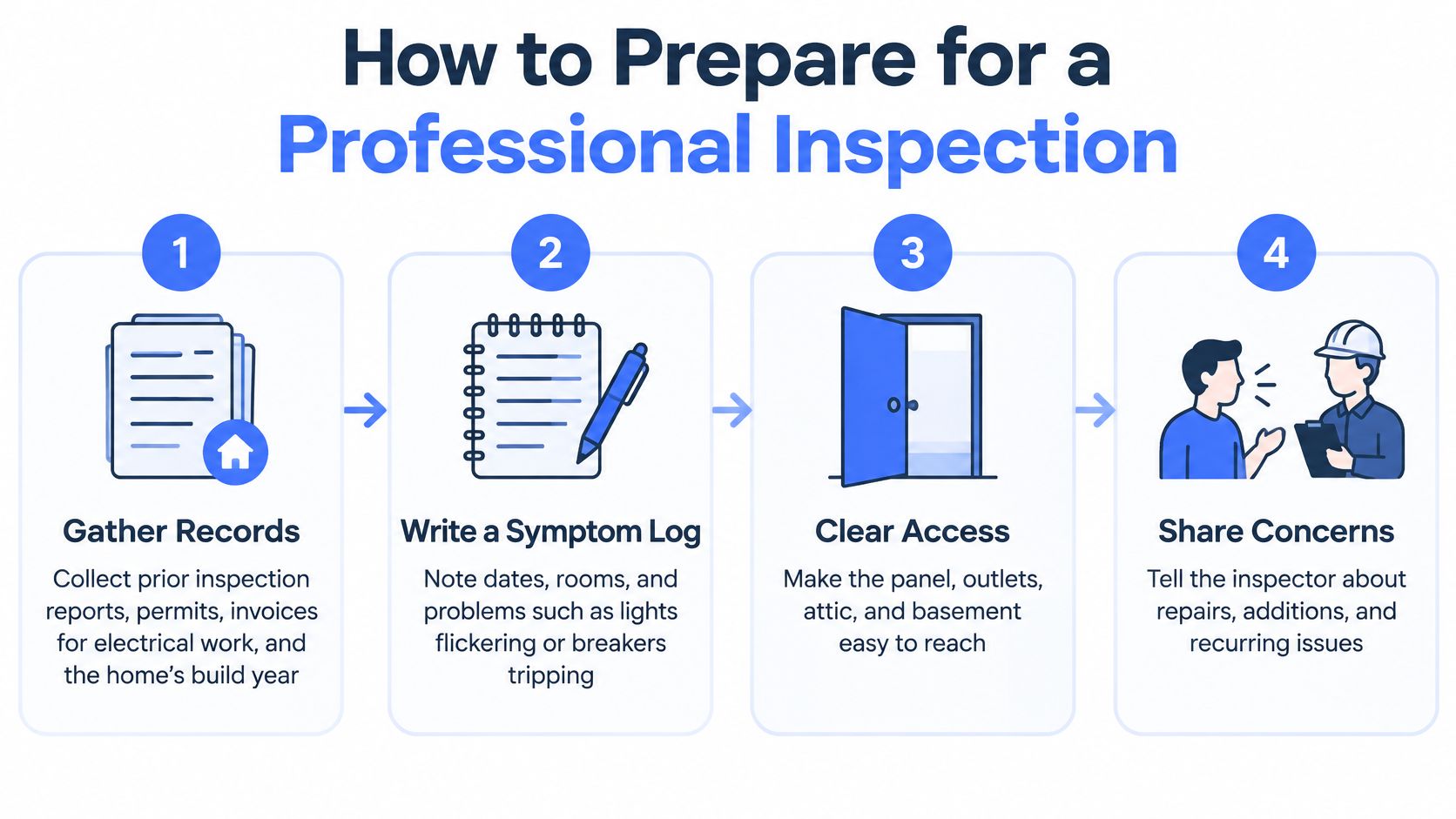
Gather records. Pull prior reports, permits, invoices, and the build year. Those papers show what already changed, so the visit doesn't treat a permitted kitchen circuit as a mystery splice.
Write a symptom log. Note the date, the room, what was running, and whether it repeats. A trip that only happens when the microwave and toaster share a circuit is a clue the electrician can try to reproduce.
Photograph, don't open. Shoot the panel door label, the breaker layout, and any scorched plate. Labels show whether anyone ever mapped the circuits. Leave the cover screws alone. Live parts sit behind that door.
Clear the path. Move storage off the panel, the attic hatch, the crawlspace entry, and the meter area. If the electrician can't stand in front of the gear, that gear isn't in the tested scope.
List large loads. Write down the range, space heaters, a hot tub, a heat pump, or an EV charger you have or plan to add. Spare breaker spaces are not the same thing as spare capacity on the service.
Flag the unknown work. Note renovations since the house was built and any do-it-yourself wiring you know about. Undocumented splices are where concealed faults hide.
Lock the scope in writing. Ask which receptacles, circuits, and protective devices will be tested, and what is excluded because it is buried, blocked, or outside the visit. That list is what the report can stand behind.
Keep pets and kids out of the work area. Have the log, the photos, and the load list on the counter when the electrician arrives.
Read the Report and Book With a Clear Scope
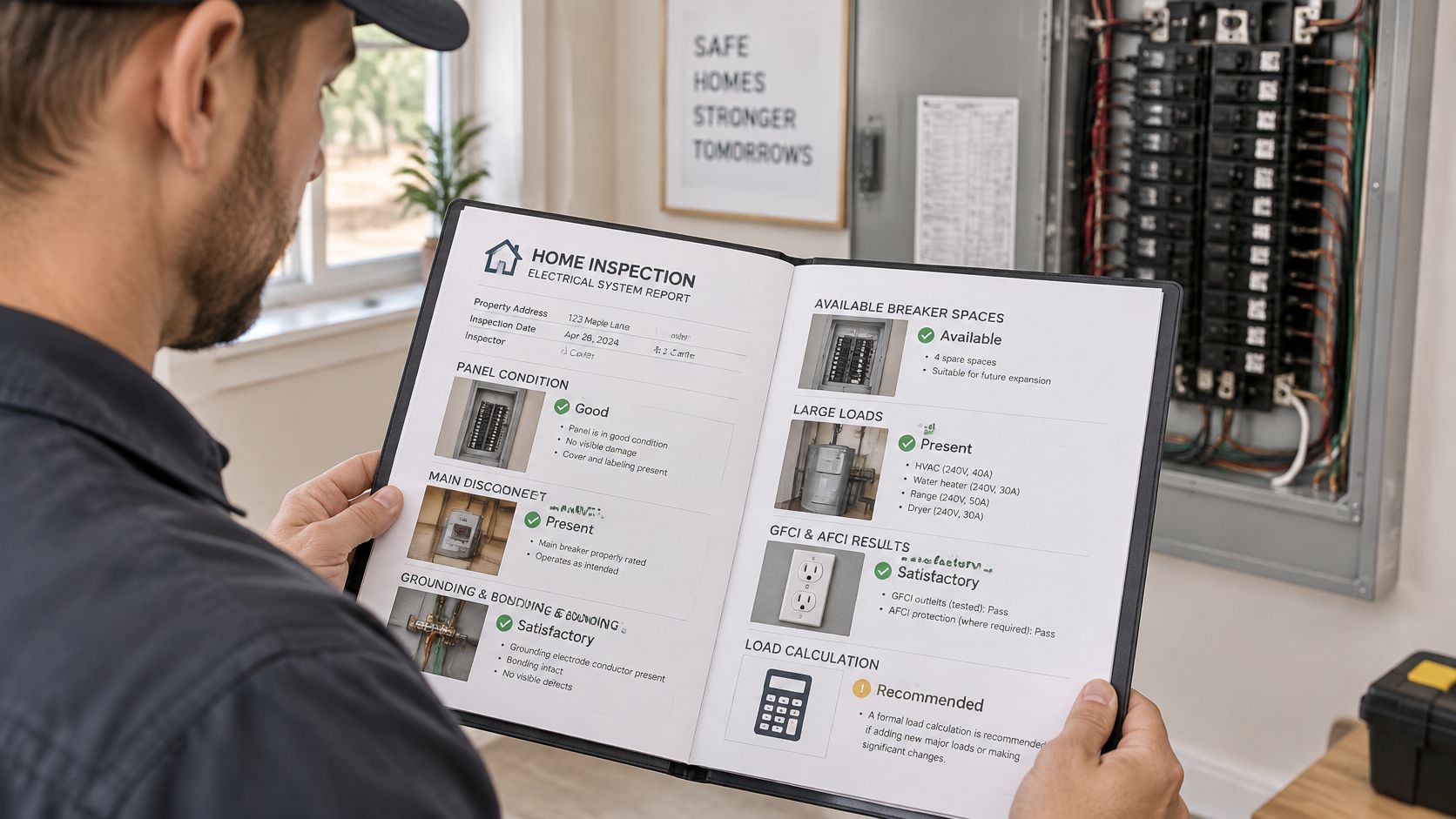
A useful report names the panel condition, the main disconnect, grounding and bonding, open breaker spaces, the large loads already on the service, GFCI and AFCI test results, and whether a formal load calculation was done. The amp rating printed on the panel doesn't, by itself, prove a new load fits. A clean panel with empty spaces can still be full once the math is done. An older panel can need safety repairs before anyone plans a charger or a heat pump.
Access Electrical and Lighting's inspection guide is a helpful second view of how a written report should read, so you can compare what you received with a clear checklist.
Sort the findings
Put every line into one of four piles.
Immediate hazards: Heat damage, a breaker that won't reset, missing grounding on a circuit people touch, or a device that failed its test. These get repaired before any upgrade talk.
Code and permit questions: Work with no permit, the wrong device for the room, or a panel that doesn't match what the jurisdiction expects now.
Load-planning data: Main rating, existing large appliances, spare spaces, and whether anyone ran the calculation.
Future-ready options: Managed charging, a subpanel, or a service upgrade, only after the first three piles are honest.
Say you're adding an EV charger and a heat pump. The report shows a 100 amp service, six open breaker spaces, an unlabeled panel, and no load calculation. Open spaces don't answer the question. Fix the safety items first, run the calculation second, and only then take quotes. If failing breakers are on that first list, our note on circuit breaker replacement cost shows why the part price is only one piece of the job.
This short walk-through shows the same idea in motion: what gets opened, what gets tested, and what a report is supposed to capture.
What to confirm when you book
Our electricians are licensed, and we work with homeowners across the Denver metro. Confirm three things before the truck rolls.
The written scope from step 7 of your prep list should name the receptacles, circuits, and protective devices to be tested, plus what is excluded. The report should rank items from most urgent to least, and it should say what was not tested because access or time didn't allow it. If a GFCI outlet is missing or fails, ask whether it can be corrected on that visit. Our electrical safety work includes GFCI outlet installation, surge protection installation, and subpanel installation.
Keep the symptom log, the records, and the load list in one folder. Call On Time Home Services at 720-722-4001 and read that scope back before you set the time.
On Time Home Services handles home electrical safety inspections, repairs, and upgrades with licensed electricians, from troubleshooting a warm outlet to planning capacity for new equipment. If your panel, your symptom log, or a remodel is telling you the wiring needs a real look, bring the scope you wrote and the rooms you care about. Visit On Time Home Services to schedule that visit.
Comments