
Circuit Breaker Replacement Cost in 2026: What You'll Pay
Replacing a single standard circuit breaker typically costs about $100 to $200 installed, including parts and labor. Panel level work costs far more, so matching your actual problem to the right scope matters more than hunting for the cheapest breaker on a shelf.
That gap surprises most homeowners, and it's where quotes go sideways. You're rarely paying for a plastic switch. You're paying for someone to confirm the switch is the problem, pick the exact device your panel is listed for, work safely around a live bus, and stand behind the result. When a breaker trips again and again, circuit breaker replacement cost is often really a diagnosis cost, and swapping the part first can turn a small repair into a repeat visit, a damaged panel, or worse.
Table of Contents
Circuit Breaker Replacement Cost at a Glance - Installed Circuit Breaker and Panel Work Costs by Scope
Reading a Replacement Quote Line by Line - What a Clean Swap Actually Includes - Where the Extra Money Shows Up - The Checklist to Run on Any Written Quote
Breaker Types and Why Protection Changes the Price - Breaker Types, Part Prices and What Changes the Job - Three Replacement Cases That Price Differently
When Repeated Trips Turn into a Bigger Repair - What the Timing Tells You - The Decision Path in Order
Panel Capacity and When the Panel Drives the Bill - Compatibility Checks Before Anyone Recommends a Panel
Confirm the Scope Before You Book the Work - Four Steps Before You Call
Circuit Breaker Replacement Cost at a Glance
A replacement breaker costs about $5 to $20 at the counter. The Angi guide to breaker replacement costs puts the same job installed at $100 to $200, which tells you where the money goes: the service call, the labor, and the fit check against your panel and circuit.
That gap is why scope beats sticker price. Access, panel age, and whether the breaker is even the fault decide which row of this table your job lands in. A breaker that trips again and again usually belongs in the diagnosis row, and quoting a swap for an unfound fault is how a cheap fix turns into a second visit.
Installed Circuit Breaker and Panel Work Costs by Scope
Scope of work | Typical installed cost | What the price covers |
|---|---|---|
Single standard breaker swap | $100 to $200 | Breaker, labor, service call, fit check against the panel |
GFCI or AFCI breaker swap | Above a standard swap | Protection device plus labor, with price set by panel fit and wiring |
Diagnosis for repeated trips | $200 to $2,000 | Testing, locating the fault, and repair when the cause must be fixed |
Full panel replacement | $519 to $2,187, average near $1,342 | New panel, bus, and breakers |
200-amp service upgrade | $1,200 to $2,000 | Higher amperage service, panel work, and labor for added capacity |
Panel relocation or heavy service work | Above a full panel replacement | Moving the panel, raising amperage, and related service changes |
Angi's published U.S. cost data puts the panel-level rows in those ranges, and your quote will still shift with region, equipment, and how hard the panel is to reach. A breaker buried behind finished drywall in a cramped closet doesn't price like one in an open garage panel. An obsolete panel with scarce breakers doesn't price like a current Square D or Eaton panel with parts on the truck.
Practical rule: If a quote falls well outside its matching row, don't argue about the number yet. Ask what's different about the job.
That question usually reveals the full story. Maybe diagnosis is included, maybe it isn't. Maybe you're being quoted a protection device instead of a standard breaker, or a panel job disguised as a breaker job. Our wiring, breaker, and electrical repair services include Whole House Rewiring, Electrical Wiring Repair, and Circuit Breaker Replacement, and even inside that range the right scope changes the bill completely. Match your problem to a row before you call anyone, and remember that the cheapest quote is often the one that skipped the fault-finding. Paying for diagnosis once beats paying for a swap twice.
Reading a Replacement Quote Line by Line
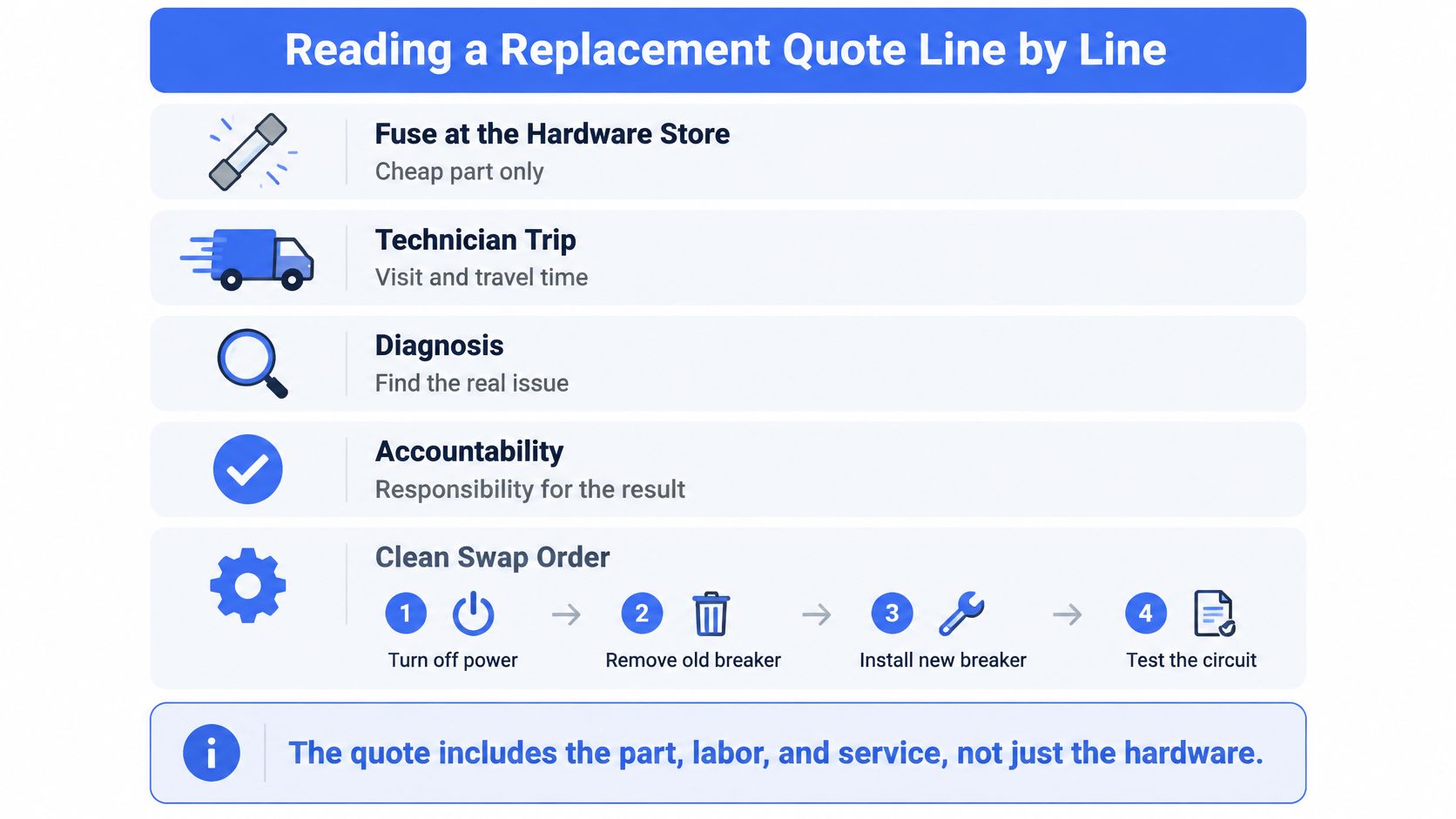
A breaker itself is the smallest line on many invoices. The service call is where the quote earns its number: travel, diagnosis, safe shutdown, correct matching, and responsibility if the circuit trips again.
You are paying for judgment that keeps a wrong breaker out of the panel. A breaker can snap into place and still be electrically wrong for that panel or circuit. The result can be conductors left underprotected, or nuisance trips that send you back to square one.
What a Clean Swap Actually Includes
A proper replacement follows an order, and each step is labor you are paying for. I would question any quote that treats these steps as optional.
Confirm the match: Identify the panel and breaker system, then verify voltage, pole count, ampere rating, interrupting rating, and manufacturer compatibility.
De-energize the work: Shut down the circuit, apply lockout where appropriate, and keep hands off live parts.
Test that it's dead: Verify with a meter, and treat the handle position or an old panel label as unreliable until proven otherwise.
Remove and inspect: Pull the old breaker and look at the bus stab and conductor for heat damage or looseness.
Install and torque: Seat the new breaker fully and torque the conductor terminal to spec with the right driver.
Restore and verify: Re-energize, confirm the circuit holds under its normal load, and check operation before leaving.
The NFPA home electrical safety guidance supports the same caution: de-energize, verify the circuit is dead, and find and correct the underlying problem before resetting or replacing protective devices. Those steps are the safety spine of the job, and they belong in the scope even when the part is inexpensive.
A straightforward swap is usually short once access is clear. The invoice rarely equals only the minutes at the panel, because electricians commonly price service calls with an hourly rate, a minimum, travel, stocked parts, insurance, and licensing folded into the visit. On Time Home Services' electricians are licensed, and a legitimate service call price carries that credential.
Where the Extra Money Shows Up
Clean swaps stay predictable. Messy conditions do not, and a good quote names them instead of burying them.
Hard access: A panel behind storage, in a tight closet, or reached through finished walls adds time before any tool touches a breaker.
Outdated or obsolete equipment: Scarce breakers for discontinued panels cost more to source, and sometimes sourcing is the wrong answer entirely.
Heat damage at the bus: A discolored or pitted bus stab can keep a new breaker from seating or carrying current safely, so repair scope grows.
Permit and inspection: Some scopes require a permit, and the fee plus inspection coordination belong on the quote in plain language.
Troubleshooting combined with the swap: Testing loads, separating neutrals, and tracing a fault are separate skilled work and deserve their own line.
The same logic applies when you compare other electrical quotes side by side. If you have looked at our breakdown of recessed lighting installation cost, you have seen how access and scope, more than fixture price, drive the final number. Breakers follow the same pattern with higher safety stakes.
The Checklist to Run on Any Written Quote
Read a quote in the order an electrician builds it. If a line is missing, ask about it before you approve anything.
Labor and parts itemized: You should see the breaker priced separately from the labor to install it.
Diagnosis stated: The quote says whether troubleshooting is included or billed as its own line.
Service call and minimums: Trip charges and labor minimums appear in writing before approval.
Breaker type named: Standard, GFCI, or AFCI is spelled out, along with brand and amperage.
Panel compatibility confirmed: The replacement is listed for your specific panel and amp rating.
Permit and inspection listed: Either they are included with a price, or the quote states they are unnecessary for this scope.
Testing included: Torque verification and operation testing under load are part of the job.
Emergency surcharge stated: After-hours work is priced openly if it applies.
Warranty on both halves: Coverage applies to the breaker itself and the labor behind it.
A low quote that skips diagnosis, torque checks, and testing is an incomplete job with a smaller number attached.
For a hypothetical comparison, say two quotes for the same tripping kitchen circuit come in at $150 and $420. The higher one includes an hour of diagnosis and a GFCI breaker the circuit needs. The lower one swaps in a standard breaker and leaves. If the fault is a leaking appliance or a ground fault downstream, the cheaper visit can lead to a second service call. That is how the lowest circuit breaker replacement cost on paper becomes the most expensive path in practice.
Watch for red flags while you compare. A quote given without asking your panel brand is a guess. A promise to upsize a breaker so it stops tripping is dangerous, because the breaker protects the wire and its termination rather than your convenience. Any price that cannot explain what happens if the new breaker trips again has left the central question unanswered.
Breaker Types and Why Protection Changes the Price
Three breaker types show up on residential quotes, and they are not interchangeable. A standard breaker watches current and opens the circuit when draw exceeds what the wire can carry. Overloads and short circuits, nothing more.
A GFCI breaker compares current flowing out against current coming back and trips the moment some of it leaks toward ground, possibly through a person. An AFCI breaker does a different job again. It watches for the erratic arcing signature that damaged insulation and loose connections produce, the kind of fault that smolders inside a wall long before a standard breaker notices anything.
Breaker Types, Part Prices and What Changes the Job
Breaker type | What it protects against | Part price | Effect on the job |
|---|---|---|---|
Standard breaker | Overloads and short circuits | Lowest part cost of the three | Usually a like-for-like match with the existing panel |
GFCI breaker | Shock from current leaking to ground | Noticeably more than standard | Needs correct wiring and neutral checks before installation |
AFCI breaker | Arcing faults in covered branch circuits | Noticeably more than standard | Must be listed and accessible, required only on covered circuits where local code applies |
The CPSC guide on ground fault protection explains that GFCIs reduce severe shock risk, and CPSC guidance says a defective GFCI breaker should be replaced by a qualified electrician. GFCI and AFCI breakers do cost noticeably more than a standard breaker, but the part is still the smallest line in the circuit breaker replacement cost. The labor is where the gap widens: protection devices involve neutral arrangement, wiring configuration checks, and trip testing that a standard swap never gets.
Three Replacement Cases That Price Differently
Most jobs fall into one of three buckets. A failed standard breaker is the simplest case. Same type, same amp rating, same brand listed for the panel, and the bill is mostly labor time.
A failed GFCI or AFCI breaker is the second case. The protection type stays, because removing it downgrades the circuit's safety, and a qualified electrician should handle the replacement. The higher part price comes with testing to confirm the new device trips and resets the way it should.
The third case is a protection upgrade. A renovation, a new circuit, or an inspection finding can trigger AFCI or GFCI protection where none existed before. That moves the job beyond a like-for-like repair into a scope change with code questions attached, and it should be priced as one.
Here's the trade-off I'd weigh. A breaker that keeps tripping after replacement points back at the circuit, and the cost at that point is diagnosis time, not another part. Skipping that diagnosis to save on the quote usually means paying for the same visit twice.
And not every older home needs an immediate AFCI or GFCI retrofit. Applicability depends on the circuit, its use, and the code your area has adopted. Anyone who tells you otherwise without opening your panel is selling, not advising. Whatever the type, the replacement still has to match your panel brand and rating. The cheapest part on the shelf isn't a deal if it isn't listed for the panel it will live in.
When Repeated Trips Turn into a Bigger Repair
A tripping breaker isn't automatically a bad breaker. More often, it's a breaker doing its job on a circuit with a real problem, and that's the assumption worth challenging before you spend anything.
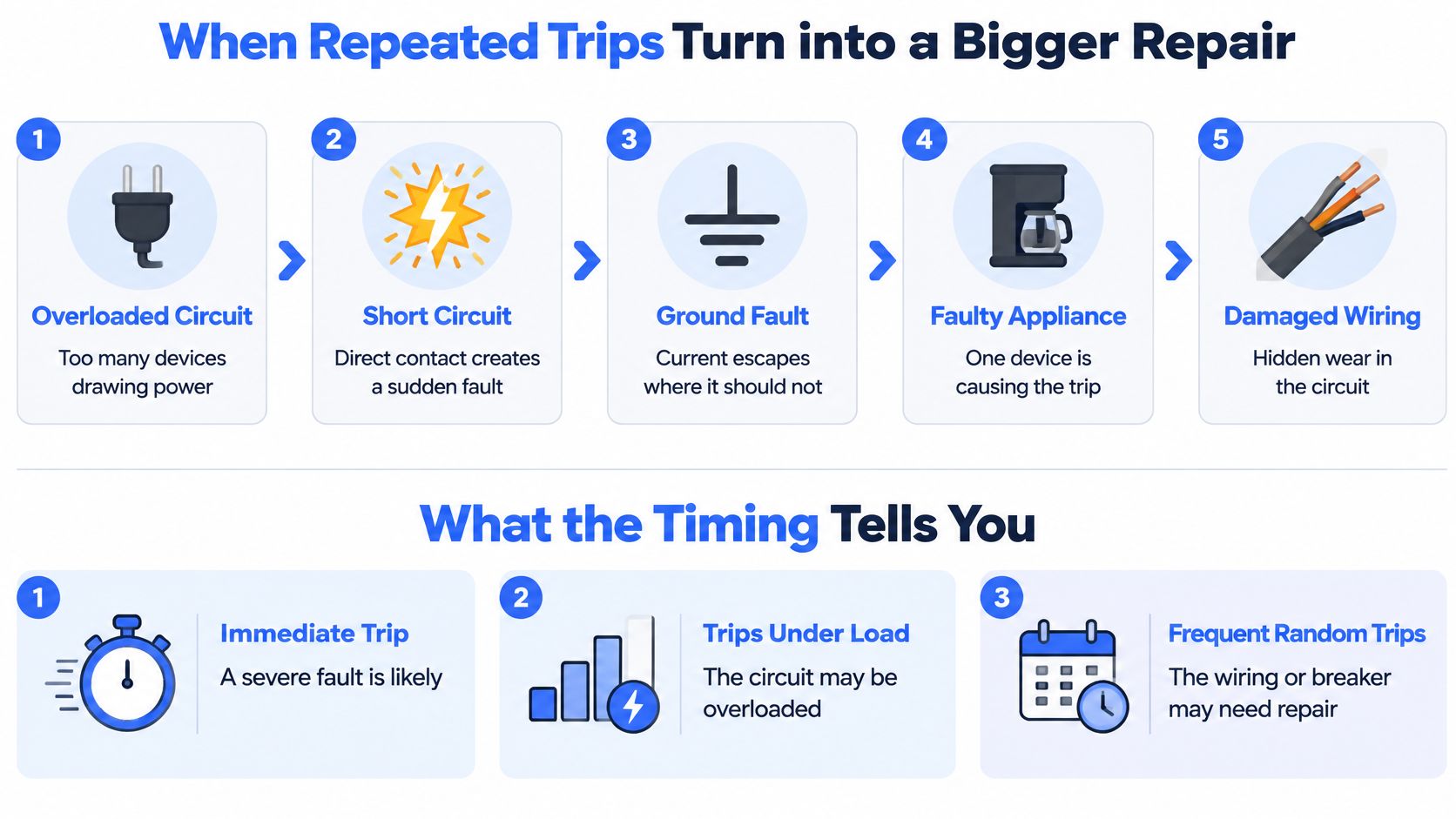
The usual culprits are an overloaded circuit, a short circuit, a ground fault, a faulty appliance, or damaged wiring. Each one produces the same symptom at the panel, a handle sitting between on and off, but each one needs a completely different fix. Replacing the breaker treats none of them.
What the Timing Tells You
When the trip happens is diagnostic information, so pay attention before you reset anything. Schneider Electric's guidance on breaker tripping, available through Schneider Electric's technical FAQ on trip causes, distinguishes magnetic trips at startup from short circuits or high inrush current versus thermal trips after sustained heating. In plain terms, an instant trip when you flip something on points toward a short or a hard fault. A trip after ten minutes of use points toward heat from overcurrent, poor sizing, or a failing load.
A space heater and a hair dryer on one bathroom circuit will trip thermally, every time, with a perfectly healthy breaker. A cord pinched under furniture can trip instantly. Neither problem lives inside the breaker, and a new breaker installed over either fault just inherits the same punishment. Severe heating can eventually degrade breaker contacts and force a replacement, but correcting the cause still comes first.
The Decision Path in Order
Work through it the way an electrician does, cheapest correct answer first.
Simple swap: The breaker itself is clearly faulty, won't hold with the load disconnected, or shows physical damage, so it gets replaced.
Diagnosis and repair: The wiring, an appliance, or the load is the cause, so testing locates it and the repair fixes that instead.
Bus bar repair: Heat has marked or pitted the panel's bus connection, so the contact point itself needs attention before any breaker will sit safely.
Panel or service upgrade: The panel can't carry the load or accept the circuits the home needs, so capacity becomes the project.
The cost jump between step one and step two is where homeowners feel misled, so put a number on it. A current electrical cost guide estimates approximately $200 to $2,000 when the underlying cause of a repeatedly tripping breaker must be resolved. That range isn't a breaker price. It's the price of finding and fixing what is wrong, which is why circuit breaker replacement cost quotes for tripping circuits should always say whether diagnosis is included. Replacing the breaker immediately can be the most expensive choice you make, since you'll pay for the swap, then pay again for the diagnosis you skipped.
Stop and call instead: A burning smell, buzzing from the panel, discoloration on a breaker, or warmth at the panel cover means stop using that circuit and get a professional evaluation. Don't keep resetting it to see what happens.
Frequent trips paired with lights that won't stay steady deserve the same caution, and our guide on how to fix flickering lights walks through how those symptoms connect. Before the visit, prepare answers to the four questions you'll be asked. What load runs on the circuit, does it trip instantly or after use, is there heat or discoloration, and does the panel accept the replacement breaker? Good answers shorten diagnostic time, and diagnostic time is what you're paying for.
Panel Capacity and When the Panel Drives the Bill
Think of a breaker as a valve on one pipe. The panel is the manifold feeding every pipe in the house. Replacing one valve will never fix a manifold that's too small, and plenty of breaker complaints are really manifold complaints.
Signs pointing at the panel include frequent trips across several circuits, flickering lights, and circuits that can't support new major appliances. A home may need an electrical panel upgrade if breakers trip frequently, lights flicker, new appliances are added, or the home still has a 100-amp panel. Adding an EV charger, an electric range, or a hot tub to a full panel exposes the limit fast.
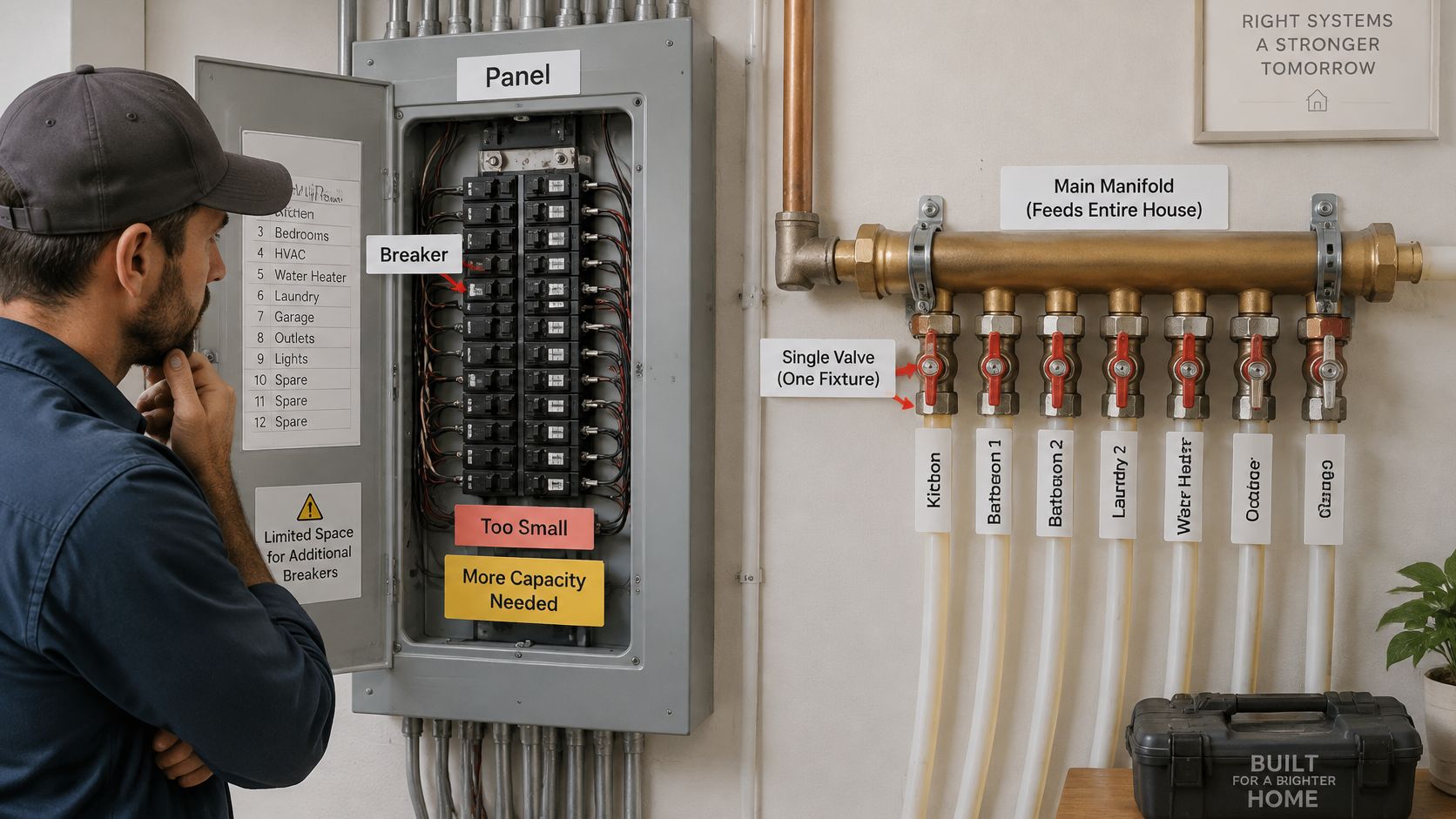
Published U.S. cost data in the Angi guide to panel replacement costs places a complete panel replacement at approximately $519 to $2,187 with an average near $1,342. That source puts a 200-amp upgrade at about $1,200 to $2,000, with electricians spending four to eight hours on the work. The gap between that and a single breaker swap is roughly an order of magnitude, which is exactly why the two jobs should never share a quote.
Compatibility Checks Before Anyone Recommends a Panel
A responsible electrician verifies several things before panel work enters the conversation.
Listed breaker brand: The breakers must be listed for that specific panel, not just physically close.
Ampere and voltage ratings: The service and panel ratings have to match the load the home draws.
Pole count and space: There must be free space for new circuits, or a plan to create it.
Condition of existing equipment: Obsolete gear, heat damage, and repeated faults argue against another patch.
Capacity questions also connect to how power reaches the building in the first place. If you're weighing service changes for a shop or commercial space, our explainer on three phase vs single phase power covers why the supply type changes what a panel can do. For most houses, though, the decision stays simpler. It's about amperage, space, and condition.
You'll receive one of three quote types, and each should say so plainly. A single breaker repair covers one device in a healthy panel. A full panel replacement swaps the enclosure, bus, and breakers at the same amperage. A service amperage upgrade raises capacity, and our electrical panel and service upgrade services include 200 Amp Panel Upgrade, Main Panel Upgrade, Electrical Service Upgrade, and Commercial Electrical Panel Upgrade. Check the scope table at the top for what each tier runs, and make sure your quote states which of the three it covers plus the amperage and breaker space it assumes. A panel quote that won't name its amperage isn't finished yet.
Confirm the Scope Before You Book the Work
The cheapest quote can be the most expensive path when it prices a swap for a problem that isn't the breaker. Your next move depends on the situation in front of you. A single failed breaker of the same type calls for a standard swap quote in the $100 to $200 range, confirmed as installed pricing rather than parts only. I would start there only when the breaker itself is clearly the failure.
A breaker that trips again and again calls for the opposite move. Stop using the circuit and book a diagnosis before any replacement, because the circuit breaker replacement cost won't fix a fault downstream. Paying for a new breaker on a circuit with a wiring fault buys you a second visit at full price. An old or completely full panel calls for a panel quote that states the amperage and space available. A protection question calls for one direct ask: whether AFCI or GFCI protection is required for that circuit under your local code.
Four Steps Before You Call
Note the pattern: Write down which breaker trips and exactly what was running when it did.
Check for warning signs: Look for discoloration, scorching, or a burning smell, and listen for buzzing from the panel; if you notice any of these, stop using the circuit and do not touch the panel.
Read the panel label: Gather the panel brand and amperage so compatibility can be confirmed on the first call.
Request it in writing: Ask for an itemized quote covering scope, diagnosis, and any permit.
We offer flexible scheduling and prompt service for unexpected home repairs, so a tripping breaker doesn't have to wait for a convenient week. Whatever you book, the written scope matters more than the number on the line. The figure that counts is the installed price with the scope written down.
If your breaker keeps tripping, you've noticed scorch marks or a burning smell at the panel, or you're staring at two quotes that don't seem to describe the same job, we can sort out whether you need a swap, a diagnosis, or a panel upgrade and price it in writing before work starts. Visit On Time Home Services to schedule a licensed electrician who will confirm the scope first, so you pay for the fix your home needs.
Comments