
Three Phase vs Single Phase Power: Which Do You Need?
If three-phase power is automatically better, why can a business with three-phase service still have overheating motors while a home charges an electric vehicle comfortably on single-phase?
The answer is that phase count doesn't tell you whether an electrical system fits its load. Equipment voltage, available capacity, circuit allocation and operating schedules matter just as much. Comparing three phase vs single phase power starts with what your equipment needs, not which supply sounds more powerful.
For Denver homeowners and business owners, the practical question is straightforward: can the existing service safely run the equipment you use, when you use it? Sometimes the right answer is a service upgrade. Sometimes it's a dedicated circuit, load management or better distribution of existing loads.
Table of Contents
Three Phase vs Single Phase Power at a Glance - What usually decides the choice
How Each Supply Delivers Power - Why motors respond differently - Smoother power isn't free
Capacity Numbers for Common Service Sizes - A hypothetical service comparison - Put an appliance into the calculation
Load Balance, Motors and Power Quality - Separate the problems before choosing a fix - Measure the building while it works
When Single-Phase Is Enough for a Home - Size charging around the household - Spend on the constraint you actually have
Business Equipment That Calls for Three-Phase Power - Motors and heating create different demands - Check the entire installation
Confirm Your Phase Requirements Before You Upgrade - Establish what the property actually has - Compare the smallest effective solutions
Three Phase vs Single Phase Power at a Glance
Single-phase vs three-phase at a glance
Factor | Single-Phase | Three-Phase |
|---|---|---|
Conductors | Residential split-phase service has two hot conductors plus neutral | Common commercial wye service has three hot conductors plus neutral |
Typical North American voltage | Residential split-phase voltage serving ordinary outlets and higher-voltage appliances | Commercial wye voltage selected to match the building and equipment |
Power delivery | Instantaneous power pulses and passes through zero with a simple resistive load | Total power is nearly constant with balanced, sinusoidal loads |
Motor behavior | Common induction motors need a starting winding or capacitor | Three-phase induction motors are self-starting and deliver smoother torque |
Typical homes | Standard for detached houses; apartment supplies require building-specific confirmation | Uncommon for individual homes; sometimes relevant to workshops or unusually heavy loads |
Typical businesses | Small offices and shops with modest equipment loads | Larger commercial buildings, manufacturing, substantial HVAC and large motors |
Relative equipment cost | Usually simpler and less expensive for light loads | Service conversion can cost more; motor and conductor advantages can help at heavier loads |
These conductor descriptions don't include the equipment grounding conductor, and they don't describe every utility configuration. A three-phase motor circuit, for example, may not require a neutral.
What usually decides the choice
Single-phase is the normal starting point for a house. Residential utilities commonly provide it, and household equipment is designed around it. Adding electric appliances doesn't automatically create a reason to change phases.
Three-phase becomes useful when equipment needs a rotating magnetic field, substantial simultaneous capacity or a commercial supply voltage. A workshop with a large compressor presents a different problem from a house with an electric range, even if both owners describe their electricity use as heavy.
Practical rule: Match the supply to the equipment and operating schedule. Don't buy a phase conversion merely because it sounds like an upgrade.
Cost also needs context. A business already supplied with three-phase power may find compatible machinery practical to install. Extending three-phase service to a residential property can involve utility work that makes an otherwise attractive equipment purchase uneconomical.
Before planning equipment, identify which column matches the building's existing service. Utility availability can settle the question before anyone calculates additional capacity.
How Each Supply Delivers Power
Alternating current, or AC, repeatedly changes direction. Single-phase power uses one alternating voltage waveform, while residential split-phase service provides two opposite-polarity legs from a transformer winding.
This panel illustration helps distinguish the incoming supply from the branch circuits serving individual appliances.
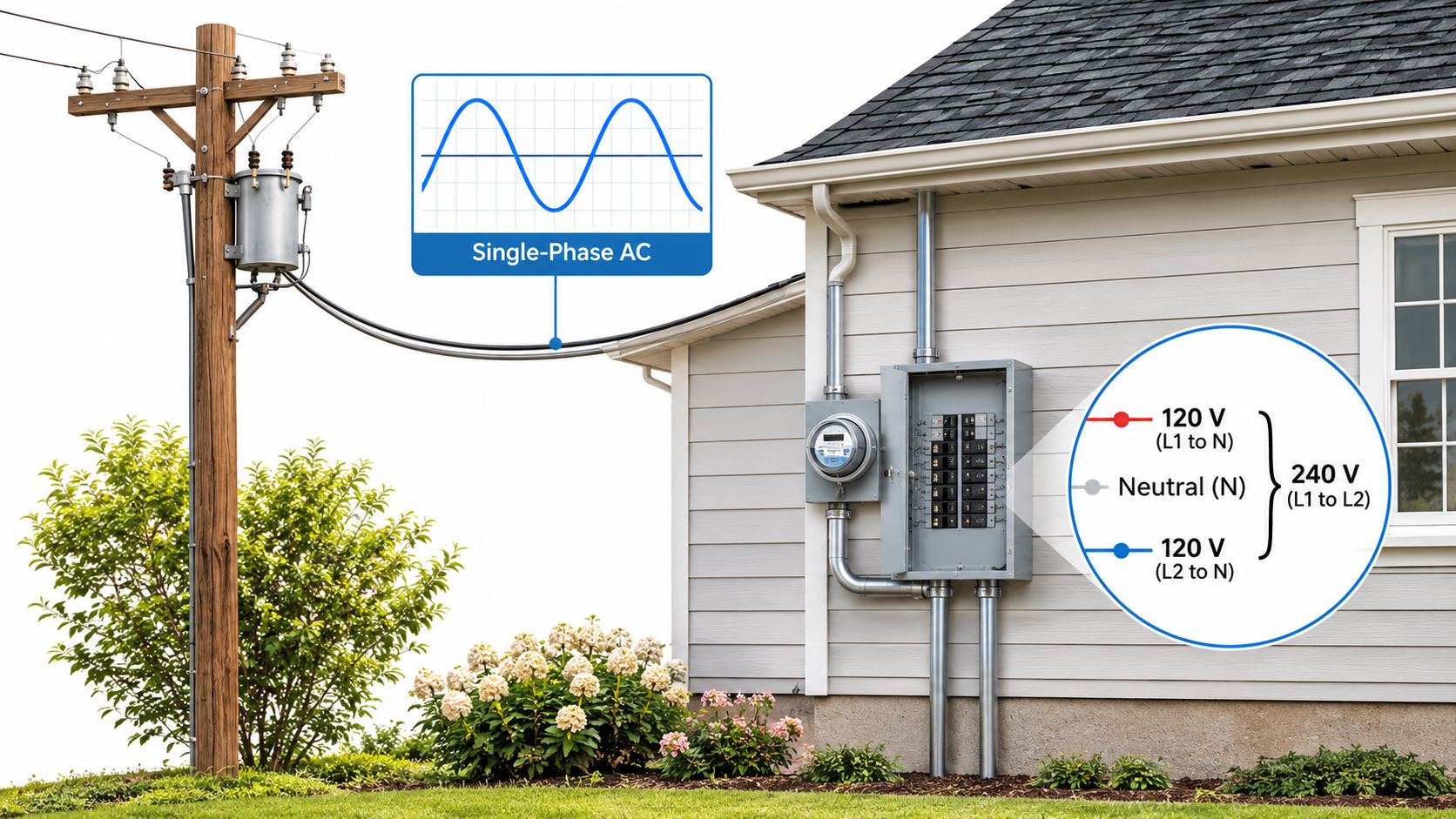
In split-phase service, ordinary circuits connect a hot leg to neutral. Higher-voltage appliances connect across both hot legs. Having two hot conductors doesn't make the service two-phase: both come from the same single-phase transformer winding.
Why motors respond differently
For a simple resistive single-phase load, instantaneous power rises and falls as the voltage changes. A single-phase induction motor also lacks a rotating starting field, so common designs use a starting winding, often with a capacitor. The starting arrangement isn't just a remedy for power passing through zero.
Three-phase uses staggered voltage waveforms. With balanced loads, their combined power delivery stays much steadier, and the motor windings create a rotating magnetic field directly.
Think of a multi-cylinder engine firing in sequence rather than a single-cylinder engine delivering separate pushes. That analogy explains the smoother torque, but it doesn't mean a three-phase motor can tolerate any supply condition. Its voltage, loading and phase balance still have to be right.
The animation below provides another way to visualize the difference between alternating waveforms.
Smoother power isn't free
Three-phase installation requires compatible distribution equipment, protective devices and wiring. Converting an existing property can also require changes beyond the customer's panel.
For ordinary household loads: Those added requirements usually offer little practical benefit.
For substantial motor loads: Smoother torque and suitable equipment options can justify the installation.
For an existing commercial supply: Using the available service may be simpler than trying to accommodate incompatible equipment.
The advantage belongs to a matched system, not to the phase label alone.
Capacity Numbers for Common Service Sizes
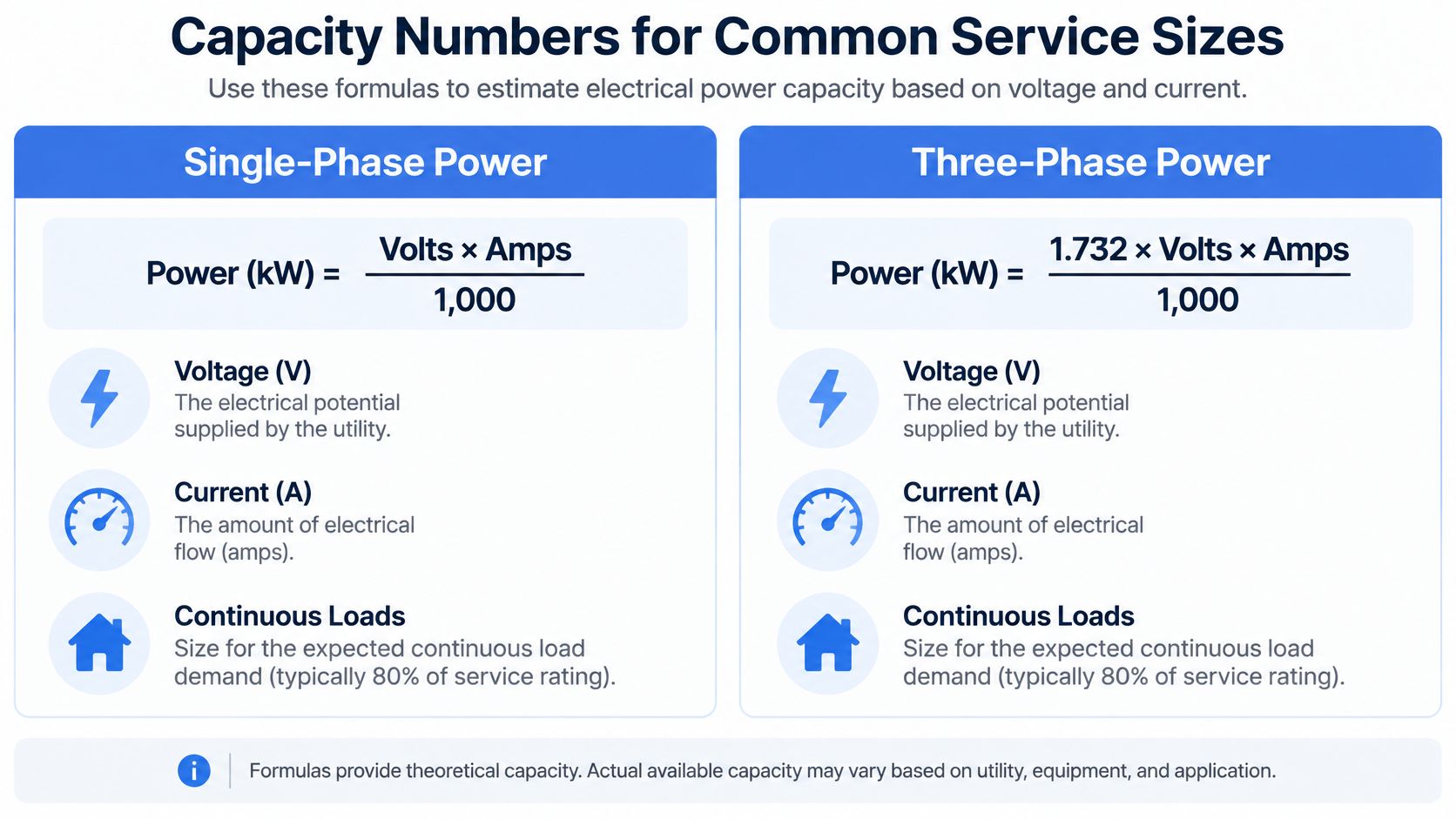
Single-phase electrical input power equals voltage multiplied by current and power factor. For balanced three-phase input, multiply line-to-line voltage by line current, the square root of three and power factor. Convert watts to kilowatts by dividing by the watts-per-kilowatt conversion factor.
The distinction matters because amps alone don't describe capacity. You also need the voltage, supply configuration and equipment power factor.
The graphic summarizes the calculation layout.
A hypothetical service comparison
The following values are worked arithmetic examples, not verified ratings for your property. They assume unity power factor and, for three-phase examples, balanced loading. The voltage and current values are hypothetical inputs.
Approximate power by supply type and service size
Supply | Voltage | Service Size |
|---|---|---|
Single-phase | Example input of 120 V | Example 20 A circuit, approximately 2.4 kW |
Single-phase | Example input of 240 V | Example 20 A circuit, approximately 4.8 kW |
Single-phase | Example input of 240 V | Example 60 A circuit, approximately 14.4 kW |
Single-phase | Example input of 240 V | Example 100 A service, approximately 24 kW |
Single-phase | Example input of 240 V | Example 200 A service, approximately 48 kW |
Three-phase | Example input of 208 V | Example 100 A service, approximately 36 kW |
Three-phase | Example input of 208 V | Example 200 A service, approximately 72 kW |
Three-phase | Example input of 480 V | Example 100 A service, approximately 83 kW |
Three-phase | Example input of 480 V | Example 200 A service, approximately 166 kW |
These are idealized electrical input capacities, not promises of usable appliance output or spare panel capacity. Motors have mechanical losses, and equipment with a lower power factor draws more current for a given amount of real power.
Put an appliance into the calculation
Say a hypothetical charger draws 48 A at 240 V. Multiplying those assumed inputs gives 11.52 kW of electrical input. That's a meaningful addition to a house, especially when cooking, clothes drying and space conditioning overlap.
The breaker isn't selected merely by rounding that current upward. An electrician must account for continuous-load requirements, equipment instructions, conductor ampacity and the applicable installation rules.
Connected load: Everything installed and capable of drawing power.
Calculated demand: The load used for service sizing after the applicable calculation method.
Available capacity: What remains after existing demand and equipment limitations are considered.
A large main breaker doesn't guarantee room for another large load. Conversely, adding appliance nameplates together can exaggerate demand when those appliances don't operate simultaneously.
Load Balance, Motors and Power Quality
Three-phase power isn't automatically more efficient. A poorly balanced three-phase installation can waste capacity and overheat equipment, even when its main breaker appears adequately sized.
Consider a business that adds office receptacles, lighting and chargers over time. If installers repeatedly use the most convenient panel positions without reviewing phase loading, one leg can become heavily loaded while the others retain unused capacity. Increasing the service size may leave that underlying problem untouched.
Separate the problems before choosing a fix
Voltage imbalance: The phase-to-phase voltages aren't equal. Motors can draw unequal currents even when their mechanical loads haven't changed.
Current imbalance: The phases carry unequal current, often because single-phase circuits have been distributed unevenly.
Neutral loading: Return current flows through the neutral. Both unequal phase loading and certain harmonics can contribute.
Harmonic distortion: Nonlinear equipment draws current in a waveform that isn't a clean sine wave, potentially increasing heating and stressing components.
LED drivers, variable-frequency drives, EV chargers and solar inverters deserve attention during a power-quality review. Their presence doesn't prove there's a problem, but a simple comparison of average phase currents won't reveal every possible issue.
The Hong Kong Electrical Energy Code example discussed in this engineering paper on three-phase load imbalance limits unbalanced single-phase load distribution to 10%; its worked example shows 10% current imbalance producing about 17 A of neutral current and increasing total copper losses by approximately 1%. That's an engineering illustration, not a Denver code threshold or a universal prediction for every building.
A service upgrade adds capacity. It doesn't automatically correct uneven loading, distorted current or poor connections.
Measure the building while it works
A licensed electrician can use a power-quality logger to record phase voltages, phase currents, neutral current, power factor and harmonic distortion across representative operating periods. Measurements should include equipment starts, busy production periods and quieter operation, rather than just an unloaded panel.
Motors deserve particular attention because imbalance and harmonics can cause heating, vibration, reduced efficiency and shorter equipment life. A motor that runs acceptably while the shop is quiet may behave differently when compressors, drives and charging equipment operate together.
The findings determine the remedy. Redistributing branch circuits may address current imbalance; connection repairs, equipment changes or a targeted harmonic assessment may address other problems. More service capacity is appropriate only when the measured and calculated demand supports it.
When Single-Phase Is Enough for a Home
Start with the energy your vehicle needs, not the highest charging rate available. In a hypothetical overnight example, replacing 40 kWh at an assumed constant input of 11.5 kW takes approximately 3.5 hours before charging losses. That arithmetic shows why a useful charging window can matter more than an unusually powerful supply.
Most homeowners benefit from a Level 2 charger for faster charging and greater convenience. In North America, useful home Level 2 charging is available on 240-V single-phase service, as discussed in the Applied Sciences residential charging study, which monitored 958 apartments for 14 days and found weekday charging demand concentrated between 19:00 and 22:00. The study compared 7.4 kW single-phase charging with 22 kW three-phase charging, illustrating both the potential charging-rate difference and the importance of overlapping demand.
Size charging around the household
That apartment study describes charging demand at shared residential service points. It doesn't establish the needs of an individual Denver house, and its charging configurations shouldn't be treated as a promise that a particular North American vehicle can accept the same power.
For a single home, the useful questions are:
Daily energy: How much charge must you replace after normal driving?
Available time: Can charging continue overnight rather than finishing immediately after arrival?
Vehicle capability: What input can the onboard charger accept?
Overlapping appliances: Will charging coincide with electric heating, water heating, cooking or clothes drying?
Service constraints: Can the panel, service equipment and utility feeder accommodate the proposed load?
Homeowner takeaway: Choose a charging rate that reliably replaces your daily driving energy within your available parking time.
Spend on the constraint you actually have
A load-managed charger may reduce charging when other household equipment draws heavily. A dedicated circuit or a conventional service upgrade may also be more sensible than pursuing three-phase utility service.
Charger installation cost depends on charger type, distance from the electrical panel, available panel capacity and whether a panel upgrade is required. If you're coordinating charging with a renovation, include other planned circuits in the assessment; our recessed lighting installation cost guide can help you organize the lighting portion of that project.
Three-phase service is rarely the first choice for an individual dwelling unless substantial motors or an unusually heavy operating profile provide a clear reason. Solar and battery equipment also need compatibility checks, but their presence alone doesn't justify changing phases.
Business Equipment That Calls for Three-Phase Power
Commercial decisions work best equipment by equipment. The following guide identifies the usual direction, but the manufacturer's nameplate and installation instructions decide the required voltage and phase.
Typical supply by business equipment or site
Equipment or Site | Typical Supply | Why It Matters | Watch For |
|---|---|---|---|
Rooftop or split HVAC with larger commercial compressors | Often three-phase | Larger compressor packages commonly use three-phase motors | Phase balance, starting conditions and exact nameplate requirements |
Larger motors | Often three-phase | Self-starting operation and smoother torque suit sustained mechanical work | Imbalance, heating, vibration and driven-load requirements |
Commercial kitchen with large heating elements | Three-phase or compatible single-phase supply | Heating loads can be allocated across phases | Simultaneous cooking demand and equipment voltage |
Fleet depot with many Level 2 chargers | Often three-phase at the building service | Distribution and load management must support multiple vehicles | Departure schedules, coincident demand and harmonics |
Machine shop with variable-frequency drives | Commonly three-phase | Drive input and motor output must suit the installation | Harmonic distortion and drive input specifications |
Small office or retail shop with lighting and computers | Often single-phase | Modest loads may not justify service conversion | HVAC, special equipment and future additions |
Motors and heating create different demands
For a workshop, motor starting and sustained mechanical load can matter more than the sum of ordinary receptacle circuits. A compressor, dust collector and production machine may need to operate together. Buying machinery before confirming the supply can leave the owner facing an unexpected utility project.
Commercial kitchens present another pattern. Resistance heating doesn't need a rotating magnetic field, but substantial heating loads can make three-phase distribution useful. The electrician must assess actual cooking combinations during peak service, not assume every heating element operates at full output indefinitely.
Fleet charging adds a scheduling problem. A depot with long overnight dwell times may use managed charging effectively, while a site with short vehicle turnarounds may need substantially more simultaneous capacity.
Check the entire installation
A variable-frequency drive isn't automatically a substitute for the utility service a machine requires. Some drives accept single-phase input, but the drive must be specifically suitable for that use, correctly sized and compatible with the motor and application.
Before authorizing a conversion, review:
Equipment compatibility: Confirm input voltage, phase, current and manufacturer requirements.
Distribution changes: Identify panel, feeder, disconnect and protection requirements.
Power quality: Review drives, chargers and inverters for their combined effects.
Growth plans: Include equipment already planned, rather than an undefined allowance for anything the business might buy.
We provide commercial electrical panel upgrades, main panel upgrades, electrical service upgrades and three-phase panel installation. A commercial panel upgrade can be part of the solution when existing distribution is undersized, but installing a three-phase panel doesn't itself create three-phase utility service.
A light office with occasional equipment use may gain nothing from conversion. A production business with compatible motors and sustained demand may have a strong case. The equipment schedule makes that distinction clearer than the business category alone.
Confirm Your Phase Requirements Before You Upgrade
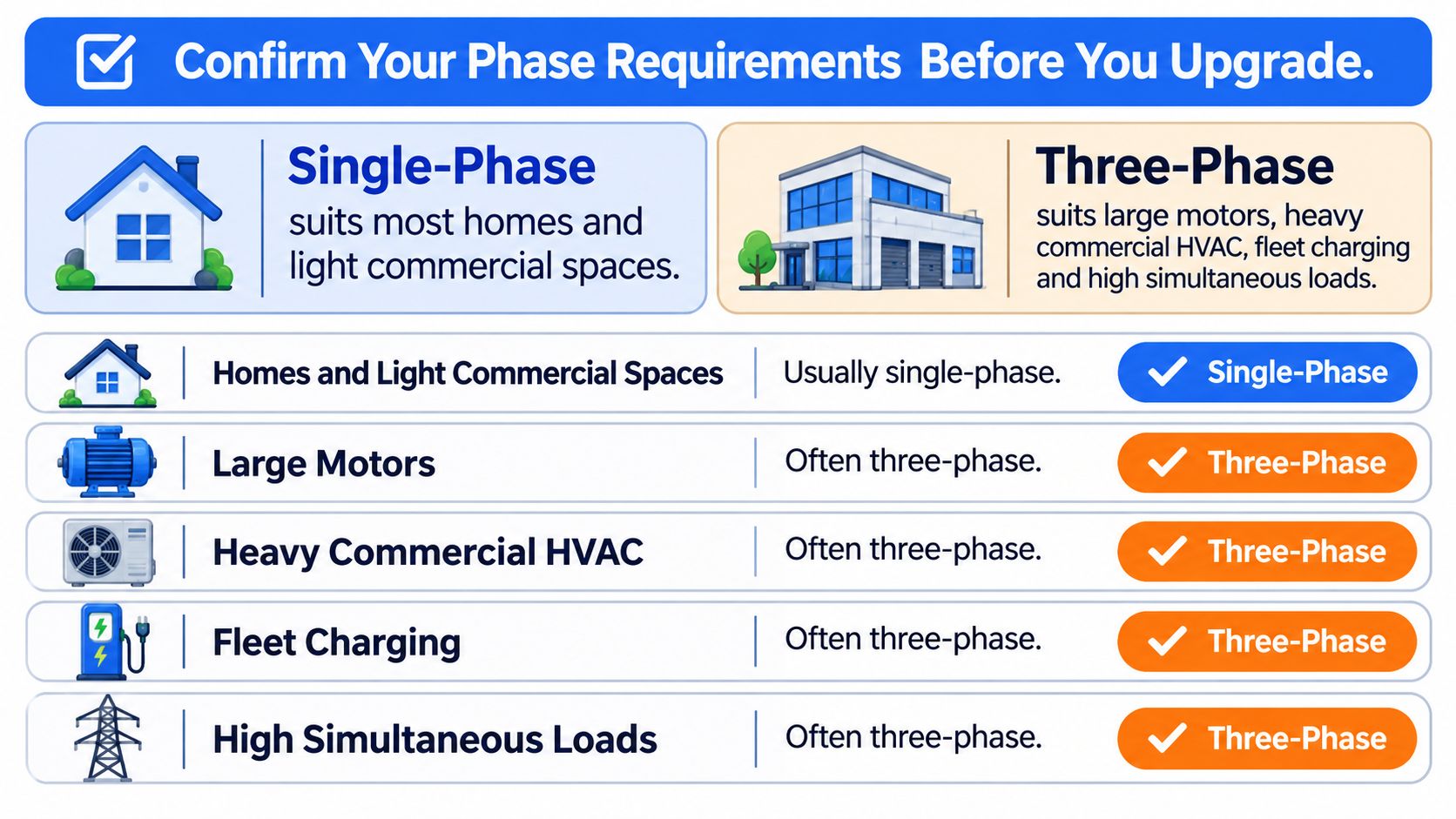
Single-phase suits most homes and light commercial spaces. Three-phase suits substantial motors, heavy commercial HVAC, fleet charging and high simultaneous loads. The right upgrade solves the building's demonstrated limitation without adding unnecessary infrastructure.
Use this visual checklist to organize the decision before requesting equipment or utility changes.
Establish what the property actually has
Identify the existing supply. Review the utility account, meter information, panel labeling and service documentation. Breaker appearance can provide clues, but it isn't sufficient to confirm every installation. Don't remove the panel cover or probe live conductors yourself.
Confirm utility availability. Ask the serving utility whether three-phase service is available at the property and what changes it would require. A nearby commercial building doesn't guarantee the same service is economical for your address.
Record major equipment requirements. Photograph accessible nameplates and collect installation manuals. Include voltage, phase, input current, starting requirements and any planned replacement equipment.
Describe actual operation. Note which machines or appliances must run together. A bakery's early production period, a workshop's compressor cycles and a fleet's departure deadlines create different demand patterns.
Compare the smallest effective solutions
Our licensed electricians can review the service rating, panel capacity and proposed equipment, then perform the applicable load calculation. Where imbalance or intermittent equipment trouble is suspected, representative power-quality measurements can help distinguish a capacity problem from a supply-quality problem.
Compare the alternatives against that assessment:
Targeted circuit work: Add a dedicated circuit or correct a distribution problem when the service has adequate capacity.
Load management: Coordinate charging or other controllable equipment around competing demand.
Panel or service upgrade: Increase capacity where the calculation demonstrates the need.
Phase conversion: Pursue it when equipment requirements and utility availability justify the added work.
Frequent breaker trips, flickering lights, new appliances or an existing 100-amp panel can indicate that a home needs an upgrade assessment. They aren't proof that three-phase power is necessary. Flickering and tripping can also result from faults, loose connections or failing components that need diagnosis rather than a larger service.
For Denver-area properties, we handle residential and commercial electrical work, including panel and service upgrades, three-phase panel installation and EV charger installation. Bring equipment information and a realistic operating schedule so the recommendation addresses your building, not a generic phase comparison.
On Time Home Services offers licensed electricians for panel and service upgrades, three-phase panel installation and EV charger installation throughout the Denver metropolitan area. Visit On Time Home Services to discuss your existing supply, planned equipment and whether a targeted change or a larger upgrade fits your property.
Comments