
Ground Fault vs Short Circuit: How to Tell and Respond
The most popular advice after a breaker trips is simple. Reset it and see what happens. That advice is backwards. A trip is information, and resetting without isolating the circuit erases the clue you need most. Worse, a breaker that stays closed isn't proof that the circuit is safe, because some faults produce too little current for that breaker to notice.
Table of Contents
Ground Fault and Short Circuit at a Glance - Where the Two Categories Overlap
Matching Symptoms to the Right Fault - Read the Timing Before You Touch the Panel - Symptoms That Depend on Load or Weather
Which Device Catches Each Fault - Breakers and Fuses Follow Excess Current - GFCIs Follow Missing Current - Three Checks You Can Make Safely
Nuisance Trips From EV Chargers and HVAC Equipment - Ask a Better Question - Two Responses That Make the Problem Worse
Reset, Repair, or Call an Electrician by Situation - When One Reset Is Reasonable - Call an Electrician Now - When the Problem Is Bigger Than One Fault
Ground Fault and Short Circuit at a Glance
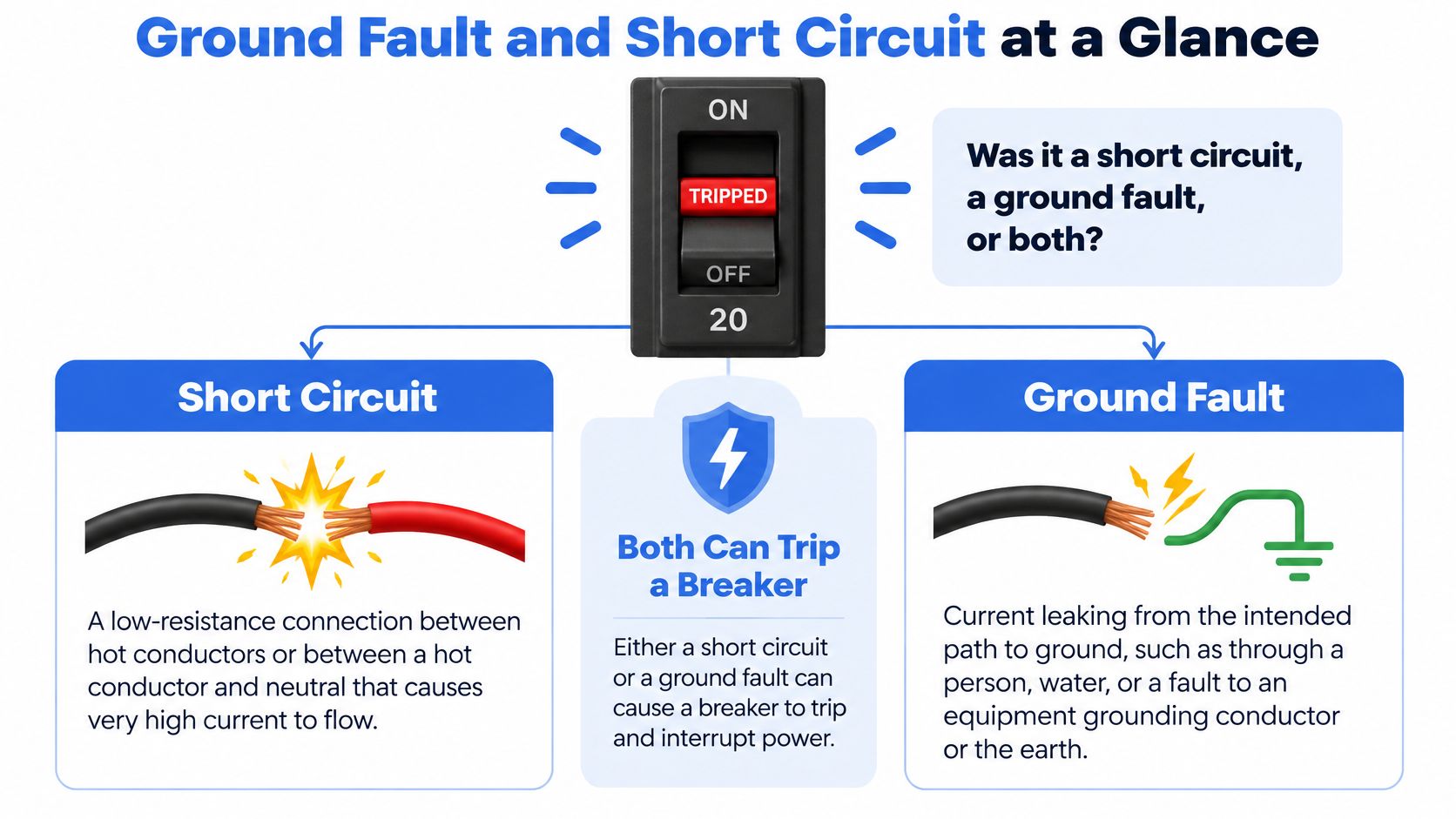
You've just reset a breaker and you're standing at the panel wondering what happened. Was it a short circuit, a ground fault, or both? In Ground Fault vs Short Circuit diagnosis, that question matters because each fault follows a different path, creates a different risk, and should be caught by a different device.
A short circuit is a low-resistance connection between conductors at different electrical potentials, such as line-to-neutral or line-to-line, as defined in the SEL protection basics presentation hosted by IEEE Houston. Current bypasses the intended load and rises fast. A ground fault is different. Current leaves its intended path and returns through ground, a metal enclosure, moisture, equipment, or a person.
Where the Two Categories Overlap
A line-to-ground fault is both a ground fault and a type of short circuit. That overlap confuses many homeowners. Not every short circuit involves ground, and many ground faults carry too little current to trip a standard breaker. The same appliance can also produce either fault depending on which conductor fails. If its hot conductor touches neutral inside a damaged cord, that's a short circuit. If the hot conductor contacts the appliance's grounded metal case, that's a ground fault.
Practical rule: Identify the current path first. The path tells you which protective device should have acted and which test comes next.
Feature | Short circuit | Ground fault |
|---|---|---|
Current path | Low-resistance connection between conductors, line-to-line or line-to-neutral | Current leaves the circuit and returns through earth, metal, water or a person |
Typical current | Very high, can reach thousands of amperes | Very high for a bolted fault, very low for leakage |
Usual responding device | Circuit breaker or fuse on overcurrent | GFCI or residual-current device on imbalance; breaker only if current is high |
Typical symptom | Breaker trips at once, sometimes with a burning smell | GFCI trips, tingling from metal parts, or intermittent breaker trips |
Shock risk | Lower direct shock risk; high arc, heat and fire risk | High shock risk even when the breaker stays closed |
First action | Switch off, unplug the device, look for damaged cord or melted insulation | Unplug, test the GFCI, check for moisture and damaged equipment |
Don't treat the table as a one-device-per-fault chart. A high-current ground fault can trip a breaker, and a short circuit can also create arcing. Your job at this stage isn't to name the fault with certainty. It's to notice which device operated, when it operated, and what was connected. Those three details turn a vague trip into a useful diagnosis.
Matching Symptoms to the Right Fault
Repeated resetting is never the diagnosis. It's only a way to re-energize a fault you haven't found. The NFPA electrical safety in the home page reports that local fire departments responded to an estimated annual average of 46,652 home structure fires involving an electrical failure or malfunction, or electrical distribution, lighting, or power-transfer equipment, during 2020–2024. Those fires caused approximately 527 civilian deaths, 1,580 civilian injuries, and $2.4 billion in direct property damage per year.
Those figures don't mean every electrical fire started as a ground fault or short circuit. They do mean unexplained trips, damaged insulation, moisture, and energized metal deserve investigation. The timing and setting of a trip often tell you more than the trip itself.
Read the Timing Before You Touch the Panel
A breaker that trips the instant you switch a circuit on usually points toward a short circuit in a damaged cord, plug, fixture, or appliance. Current has found a direct, low-resistance path and doesn't need time to build. Unplug everything before you test anything.
A GFCI that trips when you plug in a wet appliance tells a different story. Moisture or failing insulation may be letting current leak outside the normal hot and neutral path. The appliance might still run on an unprotected circuit, but that doesn't make it safe. It only means you've removed the device that detected the leakage.
Tingling from a metal appliance is not a nuisance symptom. It means current may be passing through the equipment case and through anyone touching it. Stop using it, switch off the circuit at the panel, and don't keep handling the appliance to confirm the sensation.
Symptom | Likely fault or cause | Next step |
|---|---|---|
Breaker trips as soon as a circuit is switched on | Short circuit, often a damaged cord or fixture | Unplug everything, reset once; if it trips with nothing connected, call an electrician |
GFCI trips when a wet appliance is plugged in | Ground fault through moisture or appliance insulation | Unplug, dry the outlet, test the appliance on another circuit |
Tingling from a metal appliance or fixture | Ground fault with current passing through the body | Stop using it, switch off the circuit, call an electrician now |
Breaker trips after an hour under load | Overload or heating at connections, sometimes with ground leakage | Reduce the load, check connections for heat, reset only after load is removed |
Breaker trips only in rain or humidity | Ground fault through outdoor receptacles or cords | Inspect and replace outdoor cords, check receptacle protection |
Burning smell or discolored outlet with no trip | Arcing from loose or damaged connections | Switch the circuit off, do not reset, call an electrician |
Symptoms That Depend on Load or Weather
A breaker that holds for an hour and then trips rarely behaves like a direct short. Think overload, a motor drawing heavy current, or heat building at a loose connection. Space heaters, hair dryers, microwaves, and portable air conditioners can expose a circuit that's already near its limit. Flicker that appears with those loads also deserves attention, and this guide on how to fix flickering lights is a useful separate check.
Weather-dependent trips point outdoors. Rain can enter a damaged extension cord, outdoor lighting splice, or receptacle cover and create a ground path that disappears when conditions dry. That intermittent pattern is still a fault. Dry weather has only interrupted it.
The most concerning row is the one with no trip at all. A burning smell, brown outlet, buzzing receptacle, or warm cover plate can signal arcing at a loose or damaged connection. Switch the circuit off and don't reset it to see whether the smell returns.
Reset once only after you've disconnected everything and found no sign of heat, damage, moisture, or shock.
Which Device Catches Each Fault
A short circuit and a ground fault announce themselves differently at the panel because they produce different amounts and patterns of current. According to the IEEE TechNav fault protection topic page, a short circuit is a low-impedance connection between conductors at different electrical potentials that can produce currents ranging into the thousands of amperes. Source voltage, transformer and conductor impedance, and fault-path impedance determine how high that current goes.
Ground-fault current has a wider range. The same IEEE source explains that solidly grounded systems can approach phase-fault levels, while resistance-grounded systems intentionally limit ground-fault current, often to tens or hundreds of amperes. A bolted ground fault may trip ordinary overcurrent protection. A high-impedance ground fault may not, so it needs residual-current or dedicated ground-fault protection.
Fault type | Involves ground |
|---|---|
Single-phase-to-ground | Yes |
Phase-to-phase-to-ground | Yes |
Phase-to-phase | No |
Three-phase | Only if the system is grounded |
Two of these fault types always reach ground, and a third can depending on how the system is wired. That is why ground-fault protection exists as its own category rather than riding on the same device that watches for overloads.
Breakers and Fuses Follow Excess Current
A standard breaker or fuse doesn't know where current went. It responds when current exceeds its rating long enough or rises high enough to operate. That is the right response for many short circuits and sustained overloads. It is not sensitive protection against a small leakage current passing through water, damaged insulation, or a person.
A standard breaker works like a threshold: it only reacts once current crosses its limit. A closed breaker is a passing grade on that one test. It tells you the circuit didn't exceed that breaker's operating conditions, and nothing more. It doesn't tell you that no current is leaking to ground, that no connection is arcing, or that touching an appliance is safe. The device that stayed quiet matters as much as the one that tripped.
GFCIs Follow Missing Current
A GFCI compares current leaving on the hot conductor with current returning on the neutral. If some current is missing, it may be taking another path, including through a person. The OSHA GFCI guide for construction electrical safety notes that a GFCI can disconnect power in as little as 1/40 of a second, and that current can travel through a person when the low-resistance grounding path is interrupted.
An AFCI has another job. It addresses hazardous arcing that may result from damaged cords, nails through wiring, or loose connections. Don't assume a GFCI catches arcing, an AFCI catches shock-level leakage, or a standard breaker catches both. Each device watches for a different electrical signature, so the same tripped-or-quiet symptom can point to a shock fault, an arc fault, or an overload depending on which device responded.
Three Checks You Can Make Safely
Press the GFCI test button: Use the built-in test on the receptacle or breaker and confirm that power disconnects, then reset it according to the device instructions.
Read the device label: Note whether the device that operated is a standard breaker, a GFCI breaker, an AFCI breaker, or a combination device.
Find the protected outlets: Determine whether protection comes from a GFCI receptacle that may protect downstream outlets or from a GFCI breaker at the panel.
That identification step prevents a common mistake. Homeowners often replace a dead standard-looking outlet when an upstream GFCI receptacle in a bathroom, garage, or exterior location has tripped. They also reset a combination breaker without recording which function operated, if the breaker provides that indication.
If an older circuit lacks ground-fault protection where it's needed, our GFCI Outlet Installation service can close that gap. Our electrical safety, outlet and subpanel services also include Surge Protection Installation, Subpanel Installation, and 3 Phase Panel Installation. A licensed electrician should confirm the correct device, location, wiring method, and code requirements before you swap anything.
Isolate the Circuit Before Any Reset
Work through this sequence before you touch the breaker again. The order matters because each step removes either a shock path or an unknown load.
Stop contact after any tingle or shock. Don't keep touching the appliance, faucet, or metal fixture to test it. Switch off the circuit at the panel first.
Identify the device that tripped. Record whether it's a standard breaker, GFCI receptacle, GFCI breaker, or AFCI device, plus the handle or indicator position.
Unplug every load on the circuit. Include phone chargers, space heaters, power strips, aquarium equipment, and appliances you think are switched off.
Inspect without opening devices. Look and smell for scorched outlets, melted insulation, cracked plugs, discoloration, water, or a burning odor. If you find any of those signs, leave the circuit off.
Reset the device once with nothing connected. A breaker that won't hold on an empty circuit points away from a plug-in appliance and toward the wiring, a fixture, or the protective device itself.
Reconnect one load at a time. Plug in and operate each item separately, noting the exact appliance and action that causes a trip.
Stop if the empty circuit trips. Leave it off and call an electrician rather than holding the handle, swapping in a larger breaker, or moving loads to an unprotected outlet.
A GFCI reset doesn't replace this sequence. One GFCI receptacle may protect several downstream outlets, including outlets in another room or outside. You can't isolate the fault if you don't know everything connected to that protected path.
If it trips with nothing plugged in, you've already learned enough. The next tool isn't your hand on the breaker. It's an electrician's test equipment.
Keep your notes specific: time, weather, appliance, device, and whether the trip was instant or delayed. That pattern often separates a direct short from leakage, overload, or moisture.
Nuisance Trips From EV Chargers and HVAC Equipment
A GFCI that trips every time the EV charger starts can feel like a device crying wolf. Sometimes it is. EV chargers, variable-speed HVAC systems, heat pumps, and other power electronics produce small amounts of normal operational leakage, and that leakage can interact badly with a particular protective device. Nuisance trip is the name for that symptom. The label describes what happened without proving why, because the same trip can come from harmless leakage, a developing fault, or a pairing that was never going to work.
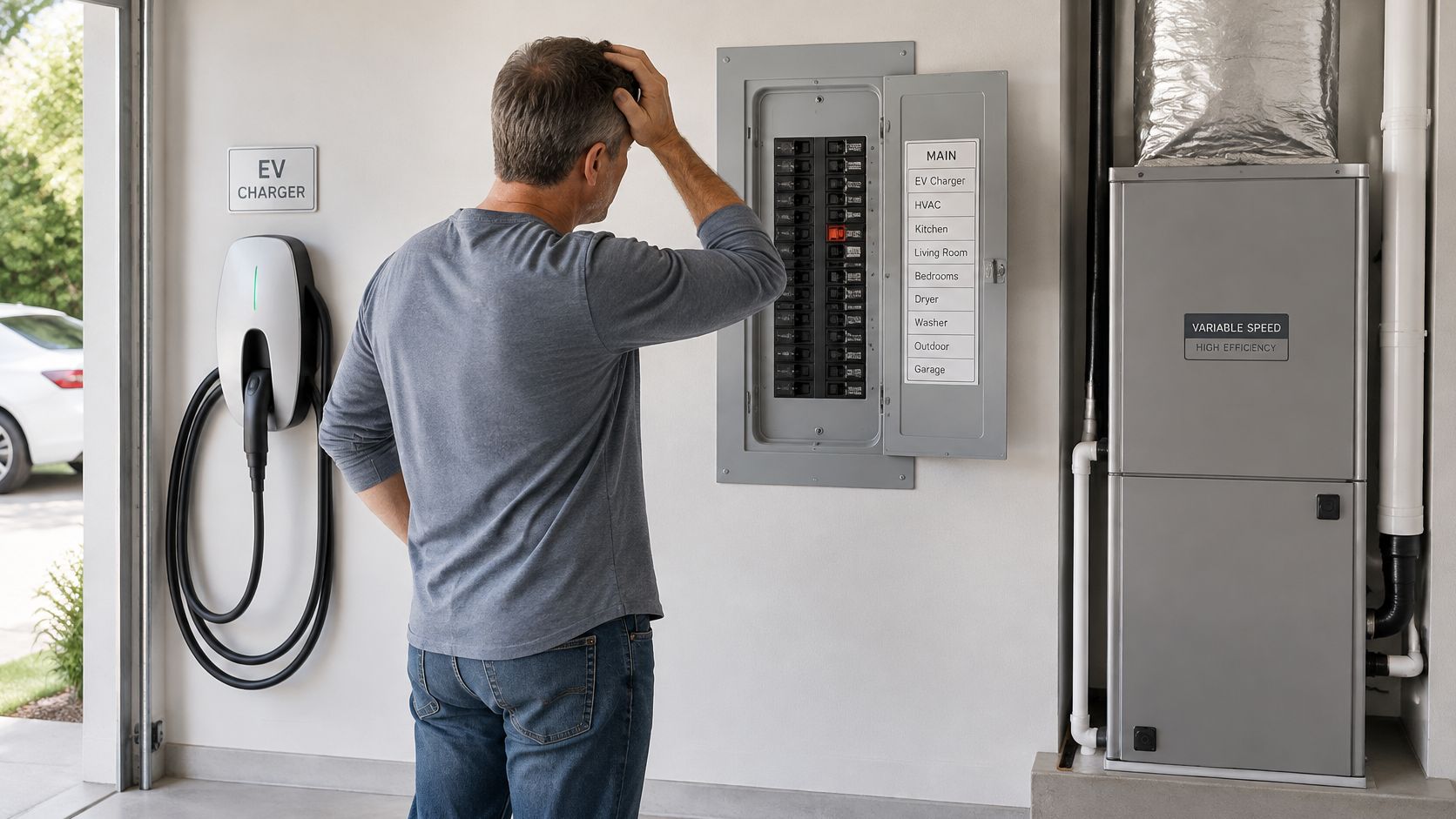
Code writers have been working on that pairing problem. The CPSC meeting log for the NFPA 70 National Electrical Code process describes how the 2026 NEC introduced or expanded special-purpose GFCI concepts, addressed compatibility concerns involving HVAC equipment, and pushed certain protection requirements for higher-voltage permanently wired EV equipment to a scheduled effective date of January 1, 2029 so manufacturers can support bidirectional current flow.
Ask a Better Question
"Ground fault or short circuit?" is rarely the useful question when modern electronics are involved. Ask four questions about the pairing instead:
Device type: Is protection provided by a standard GFCI, a special-purpose GFCI, a GFCI breaker, or protection built into the equipment itself?
Equipment leakage: What does the charger or HVAC manufacturer specify for leakage current, compatible protective devices, and installation conditions?
Trip timing: Does it trip at startup, when the compressor changes speed, during charging, in wet weather, or only after sustained operation?
Empty-circuit behavior: Does the device hold with the charger or HVAC equipment disconnected, as far as it can be safely disconnected?
The device that did not trip matters as much as the one that did. A charger that runs for months on one protected circuit and trips a different GFCI in a single afternoon is telling you something about the pairing that the trip alone cannot. Startup-only trips point toward compatibility or a transient condition. Trips that grow more frequent, repeat under the same load, or continue with equipment disconnected need fault testing. Cumulative leakage from several devices on one protected circuit can also cross the trip threshold even when each device tests acceptably on its own.
Two Responses That Make the Problem Worse
Swapping a tripping GFCI for a standard receptacle removes shock protection and fixes nothing. Repeatedly resetting it has the same diagnostic cost and may keep re-energizing damaged insulation or a wet connection. Treat an unwanted trip as a report from the protection device: deleting the device erases the report, and the cause stays in the wall.
Which NEC edition applies to a Denver-area home depends on local adoption dates and inspection requirements, so a national code discussion does not authorize a device change on its own. A licensed electrician can confirm the locally adopted requirements, the equipment listing, and the manufacturer's instructions before any breaker or receptacle gets replaced.
Reset, Repair, or Call an Electrician by Situation
Use the situation in front of you, not your frustration with the outage, to decide what happens next. A single reset can be a controlled test after isolation. Anything beyond that needs a reason.
When One Reset Is Reasonable
Reset once only if you've disconnected every load, found no damage or moisture, felt no tingling, and smelled nothing burnt. If the empty circuit holds, reconnect loads one at a time using the isolation sequence. If one appliance trips it immediately, remove that appliance from service. Don't test it repeatedly on other circuits throughout the house.
If the breaker trips again after that controlled reset, leave it off. A second or third reset doesn't give you cleaner information. It subjects the fault, breaker, and wiring to the same abnormal current again.
Call an Electrician Now
Some findings end homeowner troubleshooting:
Burning smell, smoke, buzzing, or scorch marks: Leave the circuit off and arrange urgent service.
Tingling or shock from metal parts: Avoid contact, switch off the circuit, and call now.
A GFCI or breaker trips with nothing connected: The fault may be in fixed wiring, a fixture, an outdoor receptacle, or the device.
Water inside an outlet, panel, charger, or junction box: Don't reset the device while parts remain wet or damaged.
A breaker feels loose, won't stay in position, or shows heat damage: The protective device itself may need replacement, but the circuit still needs testing first.
Our electricians are licensed, which matters because diagnosis may require measuring leakage current, testing insulation, tracing the fault path, and opening equipment that shouldn't be tested live by a homeowner. Swapping parts until the trip stops isn't diagnosis. It can mask the fault or install a device that doesn't provide the protection the circuit needs.
When the Problem Is Bigger Than One Fault
Escalate to a service evaluation when trips recur across several circuits or when the home shows broader capacity or wiring problems. A home may need an electrical panel upgrade if breakers trip frequently, lights flicker, new appliances are added, or the home still has a 100-amp panel. An EV charger, hot tub, workshop, or addition can expose limits that an older panel and branch circuits weren't built to serve.
Repairs may involve our Whole House Rewiring, Electrical Wiring Repair, and Circuit Breaker Replacement services. If replacement is part of the discussion, this overview of circuit breaker replacement cost can help you plan before the visit. A licensed electrician can also confirm whether a specific circuit needs GFCI protection, AFCI protection, or both under the applicable requirements.
Before anyone arrives, write down when the trip occurs, what was running, which device tripped, whether weather mattered, and whether it held with all loads disconnected. Bring the appliance model information if one device triggers the trip. That record lets the electrician start with the fault pattern instead of recreating it through repeated resets.
If a breaker or GFCI keeps tripping, you feel tingling from an appliance, or a circuit shows heat or burning odors, On Time Home Services can trace the fault and complete the wiring, breaker, GFCI, or panel work it requires. Our licensed electricians serve Denver Metro homeowners and businesses with fault diagnosis and repairs matched to the actual cause. Visit On Time Home Services to schedule an evaluation and bring your notes on which device tripped and what was running at the time.
Comments