
GFCI Outlet Keeps Tripping: Causes and Safe Fixes
A pot of pasta is boiling, the microwave is running, and the kitchen goes quiet. You press RESET on the outlet behind the counter, the fridge starts humming again, and dinner resumes. Two weeks later it happens again, then a third time, until resetting that outlet has become part of your routine.
That routine is worth interrupting. A GFCI that trips is doing the one job it was installed for, and the useful question isn't how to stop it but what it's reacting to. In 2023, 58% of electrical-contractor service calls involved tripped breakers or fuses, and GFCI breakers accounted for 15% of tripped-breaker cases, according to the Electrical Safety Foundation's 2023 AFCI and GFCI performance survey. Many of those calls end with a reset and a handshake. The ones that matter are the ones where the outlet was telling the truth.
The pages below separate those two situations: what you can safely observe, what each trip pattern means, and the point where a licensed electrician needs to put a meter on the circuit. Nothing here involves defeating the protection or swapping the GFCI for a plain receptacle.
Table of Contents
Why a GFCI Trips and What Each Pattern Means - Why a small leak is enough - The safety case for taking it seriously - What the timing of the trip tells you
Safe Checks to Run Before Any Reset - When the trip isn't a fault at all
When the Appliance Is the Culprit - The test that separates appliance leakage from a hazard
Older Homes, Wiring Errors and Protection Gaps - The defects that keep a GFCI tripping
Why a GFCI Trips and What Each Pattern Means
The click you hear is a small relay opening inside the device, and it fires because two currents stopped matching. A GFCI trips when the current leaving on the hot, or ungrounded, conductor doesn't return in equal measure on the neutral, the grounded conductor, as explained in CPSC technical guidance on how a GFCI responds to leakage. Anything that diverts current to earth, whether it's water in a box, insulation worn through on a cord, or a person touching a live part while standing on a wet floor, creates that mismatch.
Think of two water meters, one on the supply line and one on the drain. While both read the same, nothing is leaking. The instant the drain meter reads less than the supply meter, water is going somewhere else, and the GFCI's job is to close the valve before that "somewhere else" turns out to be a person.
Why a small leak is enough
UL 943 requires Class A personnel-protection GFCIs to trip when ground-fault current reaches roughly 4 to 6 milliamps, the same CPSC technical document notes. That is a tiny fraction of what a 15 or 20 amp branch breaker carries before it opens, which means a GFCI can trip while the circuit is drawing almost nothing and the breaker never budges. This is the most useful fact for diagnosis: repeated trips point to current imbalance, not to excessive wattage. Adding up the nameplate ratings on your appliances tells you very little.
It also explains why the device cuts power long before you notice anything. A fraction of an amp is a tingle in the hand; a shock across the chest at a few tens of milliamps can stop a heart. The threshold sits low on purpose, and the interruption happens in a fraction of a second.
A ground fault isn't the same event as a short circuit, and mixing the two up sends homeowners hunting for the wrong problem. The difference between a ground fault and a short circuit explains why a GFCI can trip cleanly while the breaker stays closed the whole time.

The safety case for taking it seriously
A tripping outlet feels like an inconvenience, and the record says otherwise. A Consumer Product Safety Commission analysis of residential electrocutions from 1995 to 1999 found an average of 196 consumer-product-related electrocution deaths per year, and estimated that 47%, about 92 deaths annually, could have been addressed by adding GFCI protection, per the CPSC report on GFCI protection and electrocution data. An earlier Underwriters Laboratories study cited in that same report estimated GFCIs were 81% to 95% effective at preventing electrocution deaths.
Read that as a reason to trust the device, not a reason to accept nuisance trips forever. The trip is a warning, not a defect. A GFCI that shuts off power has done exactly what its sensing circuit was built for, and the productive question is what it detected.
What the timing of the trip tells you
When the outlet trips matters as much as the fact that it trips. Six patterns cover most household cases, and each one points at a different part of the circuit.
Trip pattern | Likely cause | Quick check |
|---|---|---|
Trips the moment you press RESET | Ground fault on the circuit, moisture or a damaged cord | Unplug everything downstream, then reset once |
Trips only when an appliance starts | Appliance leakage or a high-frequency compatibility issue | Run that appliance alone on the outlet and note the result |
Trips during rain, humidity or condensation | Moisture inside an exterior or damp box or cover | Inspect the cover, gasket and box for water, then dry and retest |
Trips after you add one more device | Cumulative leakage from several loads added together | Remove loads one at a time and note the total that causes the trip |
Will not reset, or resets then trips | Failed self-test or a continuing fault | Stop using the outlet and call a licensed electrician |
Trips with nothing plugged in | Wiring fault, reversed line and load, or a downstream receptacle fault | Electrician testing is required |
Two of those patterns are worth memorizing. A trip that repeats over several days, in the same conditions, points to moisture or an appliance that is failing slowly, and the fix is usually physical: a gasket, a cover, a cord, a heating element. A trip that changes with the load, holding fine on one device and cutting out on three, points to leakage that adds up rather than one bad component.
The trip is a warning, not a defect. An outlet that shuts off power is doing the job it was installed for, and the question worth asking is what it sensed.
None of this replaces measurement. Pattern reading narrows the search to a circuit section, a device class or a weather condition, which saves time and money, but only a meter tells you whether the leakage is five milliamps or forty. The same trace-to-the-source discipline applies when you're troubleshoot a tripping RV breaker, where a shore-power circuit and a dozen hidden loads make pattern reading the fastest route to the cause.
Safe Checks to Run Before Any Reset
Safety comes before the RESET button. Decide first whether the outlet is safe to approach, and only then start asking why it tripped. The sequence below is ordered for that reason, and each step has a stop condition built into it.
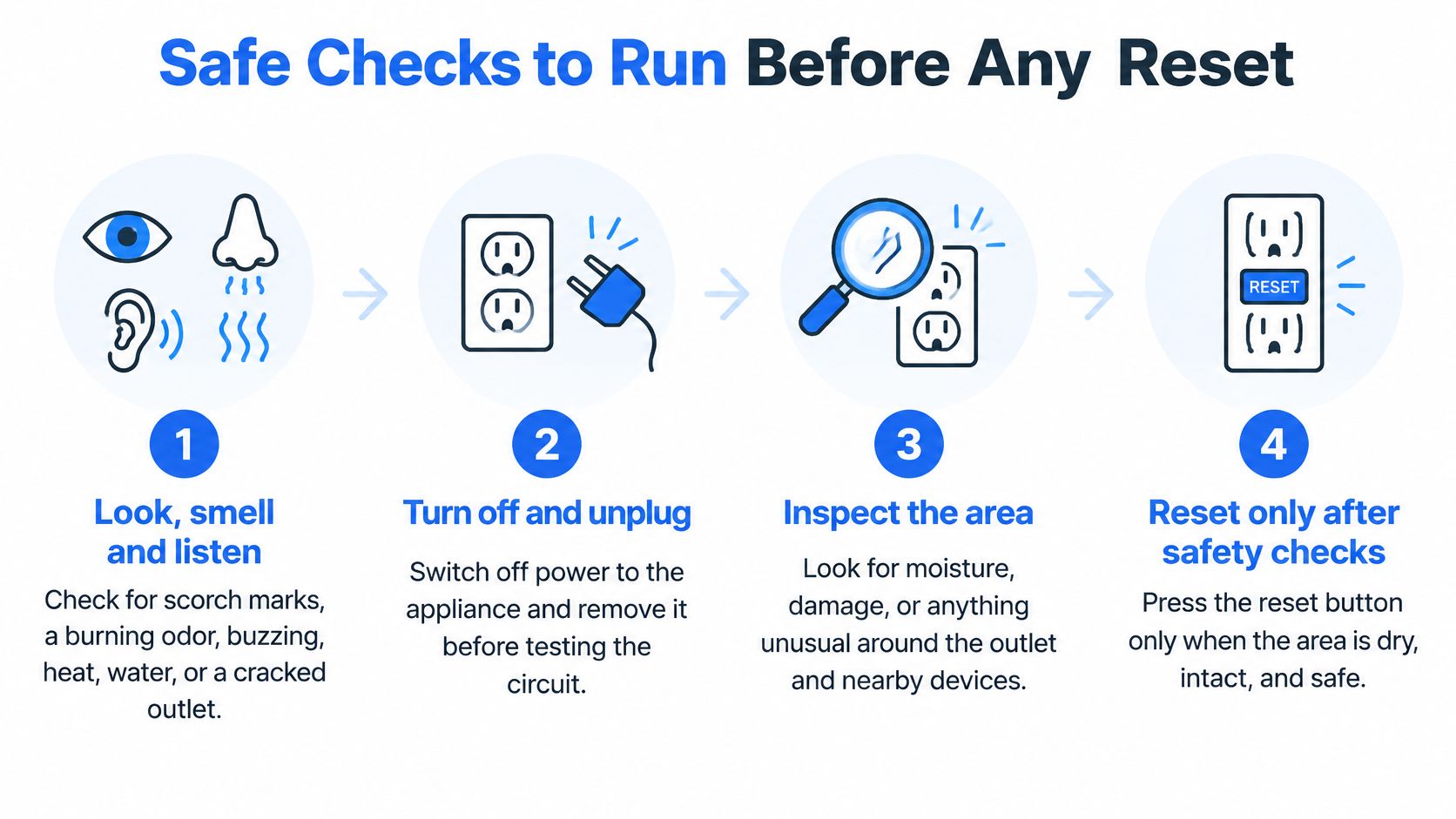
Look, smell and listen before you touch anything. Scorch marks, a burning odor, buzzing, a faceplate that feels warm, water in the box, or a cracked cover all mean stop. Heat and smell point to a connection that is failing under load, and no reset repairs a loose termination.
Unplug every load, including the ones you can't see. That means everything on this outlet and every device on receptacles the same GFCI protects, which may be in another room. A GFCI protecting downstream outlets is common, and the tripping device is often reporting something three receptacles away.
Press RESET once. If it latches and holds, the fault was in a load. If it won't latch or trips again instantly, stop and don't press it a second time. The device is telling you the fault sits in the wiring, the box, or the GFCI itself.
Reconnect loads one at a time, starting with the one you use most. Reset between each device. Whichever one brings the trip back is the suspect, and it stays unplugged until it's repaired or replaced. A hair dryer, a space heater or a countertop appliance that trips every single time is giving you a clean answer.
Press TEST, then RESET, to confirm the device still responds. A GFCI that ignores the TEST button isn't providing protection even if the outlets still have power. Test it, then restore it.
Write the pattern down. Note the location, the time, the weather, and which appliance was running. That record turns an electrician's first hour from hunting into targeted testing, and it costs you nothing.
Stop rule: if the reset won't latch, water is present in or around the box, or anything feels warm, leave the outlet switched off at the breaker until a licensed electrician has seen it.
The procedure reveals the pattern. It doesn't repair the fault, and treating a reset as a fix is how a real hazard stays in place for months.
When the trip isn't a fault at all
Some recurring trips aren't insulation faults. CPSC technical documents report that variable-speed drives in equipment such as modern air conditioners and heat pumps can generate high-frequency electrical noise and leakage, producing nuisance GFCI operation even when leakage at ordinary line frequency stays well below the trip point, per the CPSC staff comment on leakage current and UL 101. The 2020 National Electrical Code added GFCI protection for many outdoor HVAC outlets, and manufacturers and installers then reported unwanted trips and began studying equipment-to-GFCI compatibility.
A licensed electrician can measure leakage, verify that the neutral and equipment ground are separated where they should be, check grounding continuity, and confirm the installed device and the appliance are compatible under your local code. Replacing the GFCI over and over without diagnosing the appliance leaves the underlying shock hazard unresolved, and it gets expensive.
When the Appliance Is the Culprit
Here's the counterintuitive part: the outlet is often innocent. Inverter-driven air conditioners, heat pumps, electronically controlled refrigerators and variable-speed motors put high-frequency leakage onto the grounding conductor, and a conventional GFCI can read that pattern as a fault even when the appliance has no dangerous defect at all.
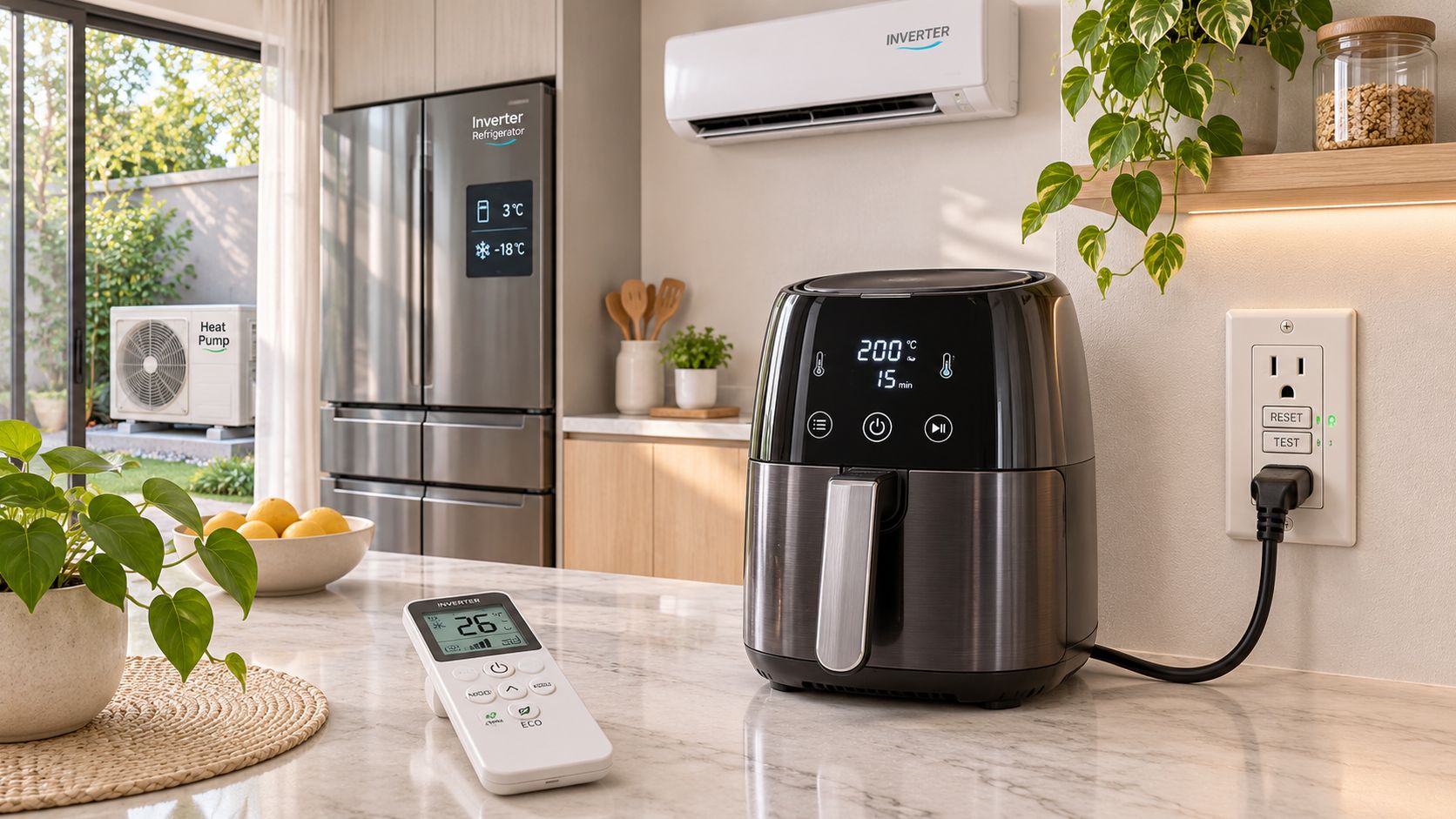
An appliance with damaged insulation and an appliance that is electronically noisy look identical from the outside: both trip the same outlet, both reset fine afterward, both repeat weeks later. The difference is where the current is going, and only testing separates them.
The test that separates appliance leakage from a hazard
Run the suspect appliance alone on the GFCI and note when the trip occurs. If it happens only when a compressor starts, an inverter ramps, or a motor changes speed, while simple loads like a lamp, a drill or a phone charger run normally on the same outlet, the appliance is the likely source. If the outlet trips with a plain resistive load and nothing else, you're back to wiring and moisture.
That observation is worth doing before anyone buys parts. Research into this problem was significant enough to change a standard. UL found interoperability problems between some refrigerators and HVAC appliances and different GFCI devices, and the findings prompted changes to UL 943; UL revised the standard in August 2025 to introduce an optional high-frequency rating and test procedure for GFCIs, as UL's explanation of high-frequency GFCIs describes.
The practical consequence cuts both ways. Replacing the outlet alone may not solve the problem, because a new GFCI of the same type will read the same high-frequency signature and trip again. Replacing a properly functioning appliance is unnecessary spending. What's needed is a measurement of the appliance, the circuit and the device together, which is electrician work, not homeowner work.
One more caution for outdoor equipment: the code change that put GFCI protection on many outdoor HVAC circuits created this friction in the first place, and the answer isn't to pull the protection out. It's to match the device to the equipment.
Older Homes, Wiring Errors and Protection Gaps
A trip can expose a defect that has been sitting inside the wall for years. GFCI requirements arrived in stages, so a house can have protection in the bathroom, none in the kitchen, and a device installed by a previous owner who guessed at the terminals.
CPSC records trace the expansion: GFCI requirements began with underwater pool lighting in 1968, then moved through outdoor receptacles, bathrooms, garages, kitchens, crawl spaces, wet bars and laundry sinks over the following decades, per the CPSC report on GFCI requirements and home electrical safety. That timeline explains the gaps you'll find in a 1970s or 1980s home.
Location | First required in |
|---|---|
Underwater pool lighting | 1968 |
Outdoor receptacles | 1973 |
Bathroom receptacles | 1975 |
Garage receptacles | 1978 |
Kitchen receptacles | 1987 |
Crawl spaces and unfinished basements | 1990 |
Wet-bar sinks | 1993 |
Laundry or utility sinks | 2005 |
The defects that keep a GFCI tripping
The same CPSC report lists what a tripping device may be exposing: reversed line and load connections, missing grounding continuity, shared-neutral problems, loose terminations, and moisture entering an exterior box. Each produces a real imbalance or leaves the protection misapplied, and none of them is visible from the faceplate.
Reversed line and load: the incoming supply must land on LINE and the downstream wires on LOAD. Swap them and the device trips erratically or leaves every downstream receptacle unprotected while appearing to work.
Shared neutrals on multiwire circuits: two circuits sharing a neutral can create a path the GFCI reads as leakage, and this trips even with every appliance unplugged.
Loose terminations: a backstabbed or under-torqued wire heats under load, and heat plus vibration eventually produces intermittent leakage. This is also the defect behind a warm faceplate.
Lost grounding continuity: a device can't do its job reliably when the equipment ground path is broken somewhere between the panel and the box.
A GFCI in one room can protect receptacles in another, so the outlet that clicks may be reacting to a fault behind a cabinet or in a garage the homeowner never associates with it. That single fact explains most of the confusion in these cases.
Protection requirements depend on location, circuit configuration and the code in force when the work was performed, and renovation work is where those questions concentrate. If a project involves permits for relocating bathroom fixtures, the electrical inspection that follows is the right moment to confirm every wet location has working protection.
A GFCI and an AFCI watch for different things, and how an AFCI breaker differs from a GFCI matters when you're working out which device is protecting which circuit. Installing a standard receptacle in place of a tripping GFCI to stop the trips removes the protection entirely, creates a code violation in a location where protection is required for a reason, and should never be done.
Telling a Faulty GFCI From a Real Fault
After you've unplugged the loads and checked the obvious defects, one question remains: is the device itself worn out? GFCI receptacles contain a mechanical trip mechanism and a self-test circuit, and both reach end of service eventually.
The signs of a failed device are specific. The reset refuses to latch with every load removed, the TEST button does nothing when pressed, or the outlet trips with nothing connected downstream while the circuit tests clean. A GFCI that fails its self-test has reached the end of its service life and must be replaced, full stop.
A device that passes TEST but trips under one particular load is usually reporting a real leakage path, not malfunctioning. That distinction is the whole game: one calls for a new device, the other calls for finding the fault.
Replacement rule: install a new GFCI only after the circuit has been tested. A fresh device on a faulty circuit will trip again, and it may mask the fault long enough for someone to stop investigating.
When a replacement does go in, the circuit conductors land on LINE and the downstream conductors on LOAD, exactly as the labels and the manufacturer's sticker show. A reversed connection leaves downstream outlets unprotected or causes repeat trips. As CSEMag's analysis of GFCI nuisance tripping puts it, concealed downstream faults and shared-neutral problems call for measurement and circuit tracing, not trial-and-error outlet replacement.
A standard receptacle is never a substitute. It removes the protection that the location requires and turns a detected hazard into an undetected one. Swapping a device is electrician work whenever the box, the wiring or the grounding is in question, and that covers most homes older than the 1980s.
When to Call an Electrician and What to Record
Some conditions end the homeowner's role immediately. These are the ones where you stop diagnosing and start calling.
Burning smell or scorch marks on the outlet, the faceplate or the cover.
An outlet or cover that feels warm to the back of your hand.
Water inside the box or standing on the cover.
A reset that will not latch, even once, with all loads removed.
Immediate trips with every load unplugged, which points at wiring rather than appliances.
Trips that started after renovation, panel or service work, where a connection may have been disturbed.
A wet location with no GFCI protection at all, such as a bathroom, garage, laundry sink area or outdoor receptacle.
Aluminum branch wiring or ungrounded circuits you can't identify, which changes how any device must be installed.
On the visit, the electrician measures leakage current on the circuit and on suspect appliances, verifies line and load connections, tests the device and the appliance together rather than separately, and checks the downstream receptacles the GFCI protects. That last step is the one homeowners can't do alone, because you can't see which outlets share the protected leg. Our electricians are licensed, and the work is confirmed against local code before anyone calls the job done. A home electrical safety inspection covers GFCI protection throughout the house, not just the outlet that's clicking.
Renovation work is the common trigger behind a sudden run of trips, and reading up on when renovation inspections happen helps you line up the electrical check with the rest of the project rather than after the walls close.
Bring the record you kept: the trip pattern, the device location, the time of day, the weather, and any appliance that was running. A note that says "trips only on the third load, only in the afternoon, only at the kitchen outlet" gives the electrician a starting test instead of a search.
On Time Home Services handles GFCI outlet installation and the wiring repairs that come out of a diagnostic visit, and a single appointment can cover the device, the downstream receptacles and the circuit feeding them. Ask for a written explanation of the findings, and let any GFCI be replaced only after its circuit has been tested.
Then take the one action that matters: if any item on the checklist above applies to your home, keep that outlet off at the breaker and call for a diagnostic visit. Protection you can't trust is worse than protection you've had repaired.
When your GFCI outlet keeps tripping, the pattern is the message, and reading it correctly is what turns a nuisance into a repair. On Time Home Services offers licensed electrical troubleshooting, GFCI outlet installation, and home electrical safety inspections across the Denver metro, so the outlet, the circuit and the appliances on it get tested together instead of one at a time. Visit On Time Home Services to schedule a visit and get a written explanation of what your GFCI has been reporting.
Comments