
Aluminum Wiring Problems: Warning Signs and Safe Fixes
You flip on the dryer and the kitchen lights dip. Or you pull a lamp cord out of a bedroom outlet and the plastic feels warm, or the faceplate has a faint brown shadow around the slots that wasn't there last summer. Nothing is smoking. Nothing has caught fire. That gap between a small oddity and an actual emergency is exactly where good information pays for itself.
If your home was built or rewired between roughly 1965 and the mid-1970s, there's a real chance the branch circuits behind those outlets are aluminum instead of copper. That fact gets repeated so often, and so loudly, that most homeowners assume the wire itself is the danger. It usually isn't. The trouble sits at the connection points: the screw terminals behind outlets and switches, the splices inside boxes, the breaker lands. Those are the places where aluminum meets a device, works itself loose over thousands of heating cycles, and starts to heat.
What follows is a plain explanation of aluminum wiring problems from that angle. What a connection does over time, which houses are affected, which visible signs deserve a fast response, and how a licensed electrician checks one specific home. Age tells you where to look. Only an inspection tells you what's there.
Table of Contents
Warning Signs of Aluminum Wiring Problems - Reading the Signs Without Panicking - What to Do in the First Ten Minutes
Which Homes Are Most Likely to Have Aluminum Wiring - How to Check a House Without Opening Walls
Why Aluminum Connections Overheat and Fail - What the Federal Record Shows, and What It Can't
Repair Options for Aluminum Wiring, Compared - The Two Trade-Offs Homeowners Misjudge
Warning Signs of Aluminum Wiring Problems
U.S. local fire departments responded to an estimated annual average of 46,652 home structure fires involving electrical failure, malfunction, or electrical distribution, lighting, or power-transfer equipment between 2020 and 2024, according to the National Fire Protection Association. In 2024, residential electrical malfunctions caused an estimated 26,400 fires, 255 deaths, 800 injuries and $1.556 billion in property loss, per the U.S. Fire Administration. Those totals cover every kind of electrical fault. Aluminum branch wiring is a narrow slice of them, but it's the slice that usually announces itself before anything ignites.
The warnings almost always appear at device boxes rather than in the middle of a cable run, which is why every sign below pairs with the connection behind it.
Symptom | Likely Cause | What to Do |
|---|---|---|
Breakers trip when a dryer, range or microwave starts | Overheated or loose termination on that circuit | Note the circuit and schedule an evaluation within days |
Lights dim or flicker when a large motor starts | Loose connection adding resistance on the shared circuit | Schedule an evaluation within a few weeks |
Outlet, switch or cover plate feels warm | Heat building at a device terminal | Stop using the device and arrange a same-week inspection |
Scorched, discolored or melted receptacle or switch | Arcing or overheating at the terminal | Stop using the device and call a licensed electrician promptly |
Buzzing or crackling outlet | Loose or arcing connection | Turn off the circuit if safe and call for an evaluation |
Burning or hot-metal smell near the panel or wall | Failing connection producing heat | Turn off power if safe, leave the area if smoke is present, and call emergency services |
Reading the Signs Without Panicking
The symptoms split into two families, and they tend to arrive in order of severity. The first family signals resistance. A dryer that makes the lights dip, a breaker that trips whenever the microwave starts, a flicker when the furnace blower kicks on. A weak joint adds resistance to the circuit, voltage sags under a large load, and the symptom shows up somewhere else in the house. That's why flickering lights that follow an appliance usually trace back to a loose connection or a shared neutral rather than a failing bulb.
The second family signals heat. A plate that feels warm to the back of your hand, a receptacle face gone brown or blistered, a buzzing at the outlet, a hot-metal smell near the panel or inside a wall. Each of these means a termination is already generating heat or arcing, and the clock is measured in days rather than seasons.
What to Do in the First Ten Minutes
Stop using the device. Unplug whatever sits in that outlet, and don't reset the breaker more than once. A breaker tripping twice on the same circuit is reporting a fault, not being difficult.
Kill power at the panel only if you can reach it safely. If the panel itself is hot, buzzing, or smells like burning metal, leave it alone and call.
Leave the wiring closed up. Re-tightening a terminal or twisting a wire nut onto aluminum without the right connector and the right torque is how a manageable problem becomes an urgent one.
Write it down. Note the room, the device, the appliance that triggers it, and when it started. Photograph any discoloration before anyone arrives.
The rule of thumb: one mild sign, such as occasional dimming, warrants a professional evaluation within a few weeks. Two or more signs, or any sign of heat, moves the call to within days. Smoke, sparking or a burning smell means everyone leaves the house and calls emergency services from outside.
Which Homes Are Most Likely to Have Aluminum Wiring
The dates below are the fastest filter a homeowner has, and they're the first question any electrician asks. They're a starting point, not a verdict.
Build or Rewiring Period | Likelihood of Aluminum Branch Wiring | Where to Check |
|---|---|---|
Before 1965 | Unlikely, but confirm with a check | Cable jacket at accessible points and the panel |
About 1965 to 1972 | Highest risk, used on general 15 and 20 ampere circuits | Panel, outlets, switches and junction boxes |
About 1972 to mid-1970s | Possible, especially in additions and rewiring | Same locations, plus any devices marked for aluminum wire |
Mid-1970s onward | Less common, but check additions and remodels | Permit records and spot checks of added circuits |
Aluminum branch wiring spread during a narrow window created by the mid-1960s copper shortage, and the U.S. Consumer Product Safety Commission documents how it moved past large-load circuits such as electric ranges and clothes dryers into general-purpose 15- and 20-ampere circuits, the ones feeding bedrooms, living rooms and kitchens. Homes built before 1965 were unlikely to contain it. Homes built, added onto, or rewired from roughly 1965 through the mid-1970s could.
The concentration matters more than the calendar. A CPSC national survey found that homes built before 1972 with aluminum wiring were 55 times more likely than comparable copper-wired homes to have at least one outlet connection reach what the agency termed a "fire hazard condition." One outlet connection, not the whole system.
The historical record is blunt about what a single bad joint can do. On April 28, 1974, a house fire in Hampton Bays, New York, killed two people after officials determined that an overheating aluminum-wire connection at a wall receptacle caused it, according to the same agency document. That's the reason the 1965 to 1972 window gets flagged so aggressively, and also the reason a date alone can't clear a house.
How to Check a House Without Opening Walls
Cable jacket. Look at any exposed run in the basement, crawlspace, attic or garage. Aluminum sheathing is usually printed with "AL" or "ALUMINUM" every few feet.
The panel. Where branch cables land on breakers, copper ends read orange-pink and aluminum ends read silver-gray. Keep the deadfront on and ask for the interior to be checked rather than prying it open.
Device markings. With the breaker off, pull a cover plate. Devices rated for aluminum carry a CO/ALR or AL marking on the strap. An ordinary receptacle doesn't.
Paperwork. Remodel permits, inspection cards and the seller's disclosure often record when circuits were added, which is how a 1960s house ends up with aluminum in one newer room.
A home inspector can flag aluminum in a report, but a general inspection doesn't confirm the condition of the terminations behind each device. Identification comes first. The repair decision comes after, and only once someone has opened the boxes.
Why Aluminum Connections Overheat and Fail
The failure starts with a screw and a temperature swing. Picture a steel terminal screw clamped onto a soft aluminum conductor. Current flows, the metal warms and expands. The load switches off, it cools and contracts. Aluminum moves more than the steel around it, so with every cycle the joint creeps a little, clamping force drops, and the connection ends up slightly looser and slightly hotter than it was the cycle before. A joint that ran cool for a decade can be a heat source by the time a homeowner notices a warm plate.
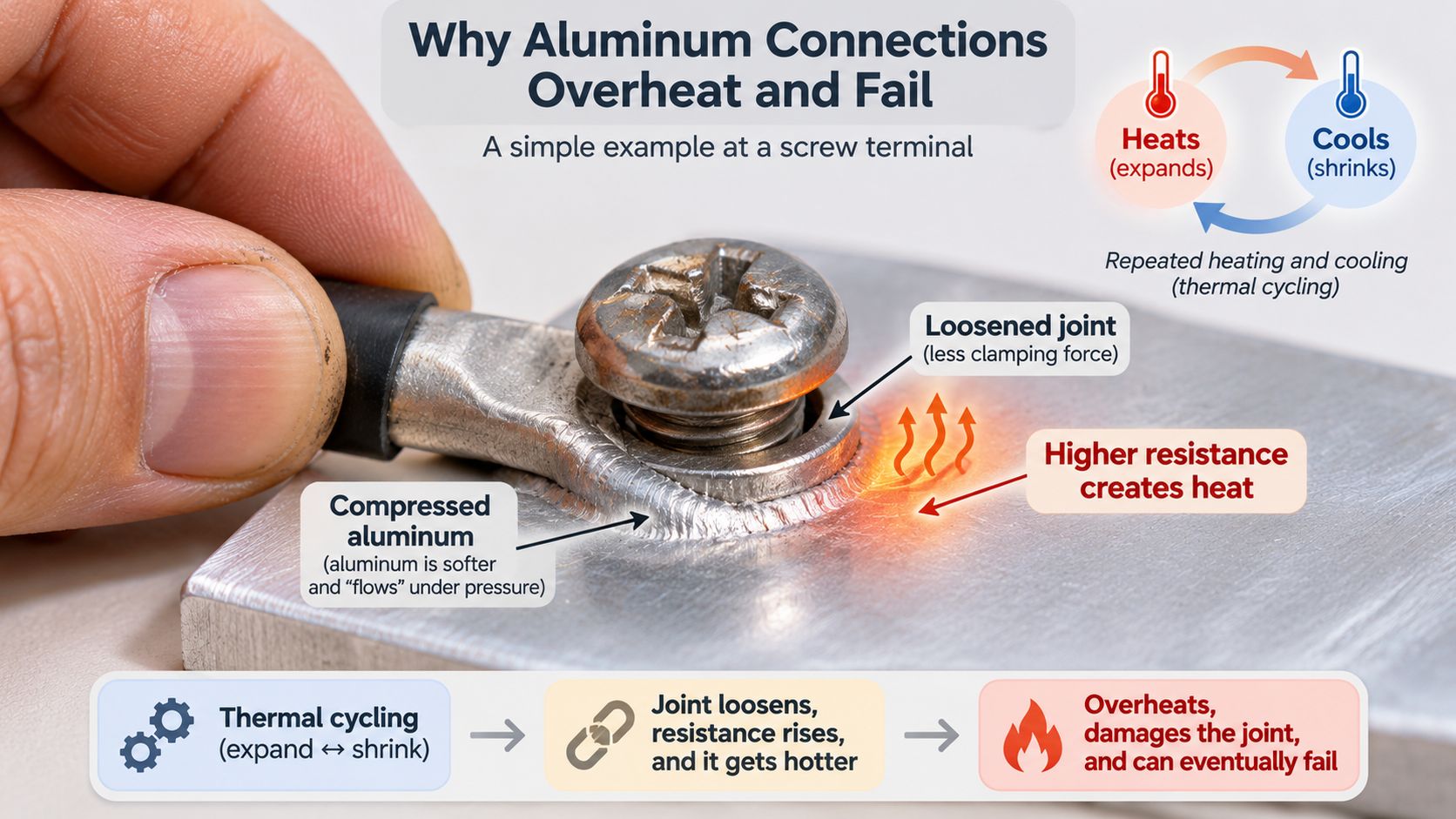
Three physical properties drive that loop:
Thermal expansion and creep. Aluminum expands and contracts more than copper under normal load and deforms under sustained pressure, so screw terminals loosen over years of ordinary use.
Oxide buildup. Exposed aluminum forms an oxide layer that resists current, unlike copper oxide, so resistance at the contact climbs and the heat rises with it.
Dissimilar metals plus moisture. Where aluminum meets a copper-rated terminal, moisture accelerates galvanic corrosion at the contact and pushes resistance higher still.
Heat concentrates at the weakest point: a device terminal, a splice inside a box, a breaker land. The undisturbed cable inside the wall rarely fails on its own.
This short video walks through how heat at a failing connection becomes an ignition source.
Where that sequence ends is well documented. A failing joint heats, arcs and ignites nearby material, and the Eagle Restoration electrical fire guide traces how that ignition path develops inside a wall and what the damage pattern looks like afterward.
What the Federal Record Shows, and What It Can't
In a 1975 preliminary determination, the CPSC counted 165 electrical-failure incidents involving aluminum wire before August 1974, as recorded in the National Bureau of Standards report on the investigation. Of those, 103 occurred in single-family homes, 38 in mobile homes and 24 in multifamily dwellings, and 32 of the 165 involved larger No. 6 or No. 8 conductors rather than the No. 10 and No. 12 wire used on branch circuits. The Commission also suspected aluminum connections in three fires that caused four deaths.
Then comes the caveat that honest writing on this topic has to include. A National Bureau of Standards hazard assessment reviewed the same field data and concluded they were insufficient to produce a reliable estimate of consumer risk or a statistically valid aluminum-versus-copper comparison. Nobody can hand you a percentage chance that your particular house burns.
Aluminum isn't the fire risk. A loose connection on aluminum is.
The documented hazard is a defective termination. The only reliable way to judge a specific home is to open the devices, look at the joints, and test them under load.
How Electricians Evaluate Aluminum Wiring
An evaluation isn't a glance at the panel and a nod. It's a device-by-device inspection of the circuits where aluminum is present, and it should end with a written record you can hand to a buyer, an insurer or the next electrician.
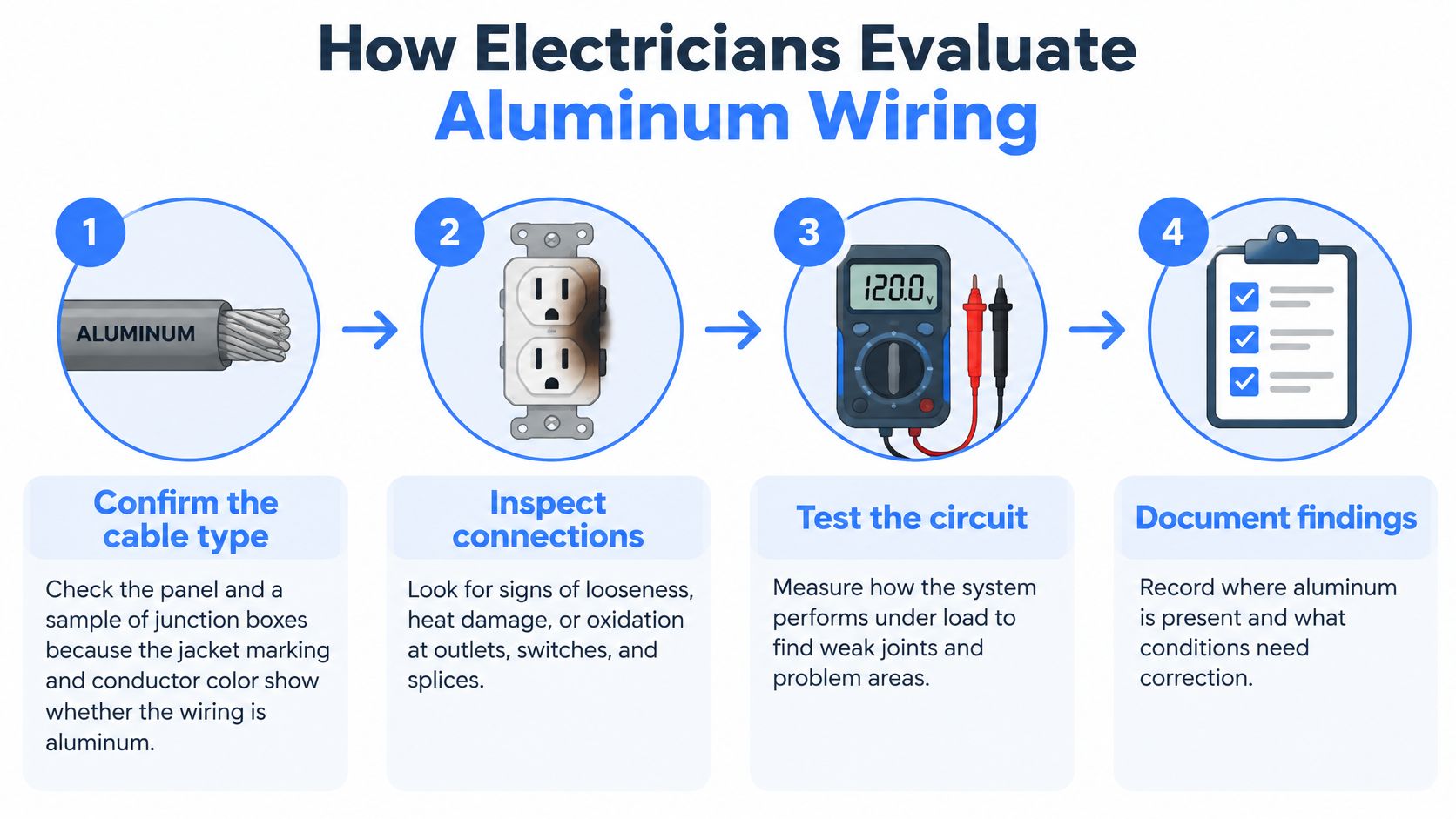
Confirm the cable type. The jacket marking at the panel and at a sample of junction boxes settles whether aluminum is present. The common slip is treating every silver conductor the same, when heavy aluminum feeder cable to a range or subpanel is a different product with a different record.
Inspect every device on the suspect circuits. Cover plates come off, and the electrician looks at terminal screws, push-in backstabbed connections, discoloration, melted insulation and wire ends that have gone brittle. Backstabs are a known weak point on any wiring and worse on aluminum.
Check each device's rating. A CO/ALR or AL marking on the strap shows the device is listed for aluminum conductors. A standard receptacle on an aluminum conductor is a mismatch even if it hasn't failed yet.
Torque the terminals to the manufacturer's specification. This takes a torque screwdriver, not a wrist. Tightening by feel until it seems snug is the most common shortcut, and it either leaves the joint loose or crushes the conductor.
Scan with a thermal camera under normal load. With the circuit energized and a real load on it, an infrared camera finds hot joints a visual check can't see. Scanning with everything switched off finds nothing, which is the trap.
Match breaker and conductor size to the load. Oversized breakers, shared circuits and added appliances all change how much current a weak joint carries before it complains.
Document the findings. Photos of each affected device, a list of circuits by room, and a short written summary. Without that record, every later conversation starts over.
A broader home electrical safety inspection covers grounding, bonding and panel condition alongside the terminations, which matters because aluminum problems rarely live alone in a 1960s house. If you want to run a homeowner-level check before anyone arrives, this guide to checking your home's wiring and panels covers what's safe to look at yourself and what isn't.
Our electricians are licensed, and any provider you hire should be able to show the same before touching a box. Ask for the written findings before a repair method is chosen, not after.
Repair Options for Aluminum Wiring, Compared
The five options below run from least to most invasive. Which one fits depends on what the evaluation found at the connections, not on the year the house was built.
Option | What the Work Involves | Best Fit | Main Cost Driver |
|---|---|---|---|
Connection remediation | Inspect, clean and retorque terminations, then replace damaged devices | Isolated defects in otherwise sound wiring | Number of affected devices and their access |
Rated device replacement | Replace outlets and switches with devices marked for aluminum conductors | Devices showing heat damage or loose terminals | Number of devices and wall access |
Pigtailing | Splice short copper leads to aluminum conductors with listed connectors | Circuits with sound cable but worn devices | Number of circuits and junction boxes |
Partial rewire | Replace aluminum branch runs with copper on selected circuits | Problems concentrated in one area or floor | Run length and wall or ceiling access |
Whole-house rewire | Replace all aluminum branch wiring with copper | Widespread defects, renovation, or a buyer's requirement | Square footage, finishes and access |
The Two Trade-Offs Homeowners Misjudge
The first is expecting device replacement to solve the whole problem. Swapping in aluminum-rated receptacles fixes the box you can see. It does nothing for splices at ceiling fixtures, junction boxes in the attic, or the panel, and those are connections too. Rated devices are a real improvement over standard ones at the same location, not a remedy for the system.
The second is assuming a rewire is the only honest answer. When the cable is intact and the connections are sound or correctly pigtailed, tearing out walls buys you very little. A full rewire earns its cost when defects show up across many circuits, when a renovation is opening the walls anyway, or when a buyer or insurer requires copper throughout.
Pigtailing with listed connectors is the middle path most older homes land on: the aluminum stays in the walls, and every connection point gets a short copper lead that ordinary devices can accept. It's slower than swapping outlets because every box gets opened, and the count of boxes drives the price.
Our wiring, breaker and electrical repair services include whole house rewiring, electrical wiring repair and circuit breaker replacement, which are the same categories of work these options describe. For a fuller picture of what the most invasive option involves, this breakdown of whole-house rewiring costs covers what drives the number.
Match the fix to the finding. A written evaluation that names each affected device is what separates a real plan from a template quote.
Whatever method you choose should be permitted and inspected where your jurisdiction requires it. Those records matter at resale and when an insurer asks what was done.
Three Common Scenarios and What Happens Next
The situations below are illustrative rather than documented cases, but each follows a pattern that repeats in older neighborhoods.
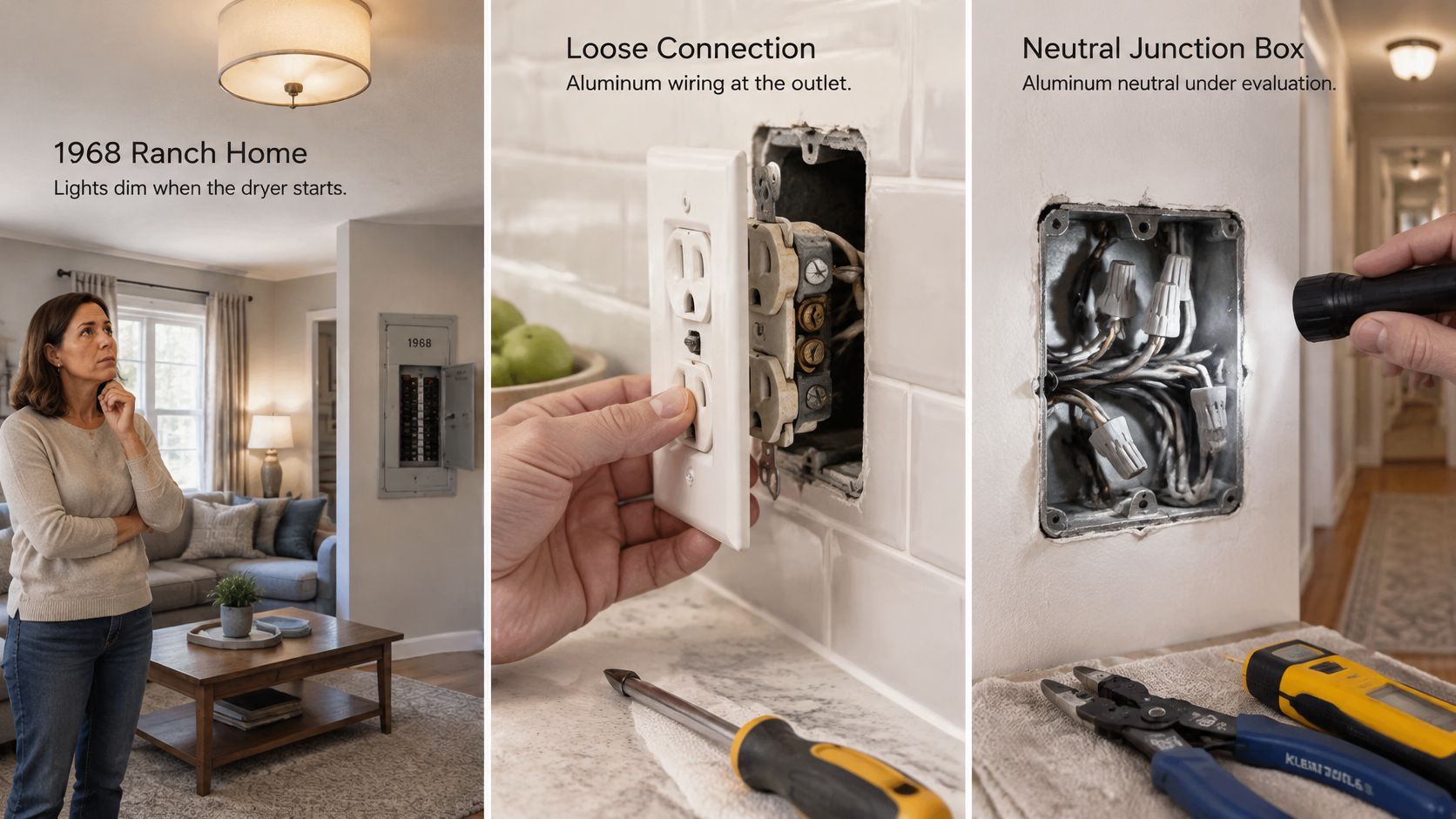
The 1968 ranch with dimming lights. The lights dip every time the dryer starts. An evaluation finds a loose receptacle with heat damage on one circuit and sound connections everywhere else. The fix is rated devices plus pigtailing on that single circuit, leaving the rest of the house untouched. The sign pointed to one joint, and the repair matched it.
The 1970 bungalow under contract. A buyer's inspector flags aluminum branch wiring and the deal stalls. The seller commissions a written evaluation, which reports intact cable but several worn devices, mostly in the kitchen and main bathroom. The parties negotiate a repair credit against that written scope rather than a full rewire, and the sale closes. The report did the work a verbal estimate couldn't.
The 1966 split-level with one warm outlet. A bedroom outlet feels warm to the touch. Inspection finds the same device problem in two more rooms on adjacent circuits, all installed the same year by the same crew. Because the pattern repeats across three rooms, the electrician recommends a partial rewire of those circuits instead of pigtailing each box.
Three houses from the same decade, three different answers. What decided each one was the condition of the terminations, not the construction date.
Confirm Your Wiring Before You Decide
Here's the decision rule worth carrying away. If the home was built or remodeled in the roughly 1965 to mid-1970s window, or if any sign from the first table has appeared, schedule a professional inspection before you buy, sell or authorize a repair. Everything else follows from what that inspection finds at the connections.
Four questions separate a real evaluation from a sales visit:
Scope and evidence. Does the inspection include a written evaluation of every termination on the suspect circuits, with photos of each affected device?
Device ratings. Which outlets and switches are rated for aluminum conductors, and which need replacing?
Reasoning. If a repair is recommended, does the plan explain why that option beat the alternatives?
Paperwork. Will the work be permitted, inspected, and the records left with you?
On Time Home Services is a Denver Metro electrician, and one of the providers you can hold to those questions. Buyers comparing properties often review the electrical system alongside everything else, and this guide to checking electrics before buying a flat shows how that review fits into a purchase decision rather than trailing behind it.
An inspection can confirm that a specific home is safe as wired or tell you exactly which connections need work. No rule based on a construction year can do either.
If your home dates to that 1965 to mid-1970s window, or an outlet has started feeling warm, On Time Home Services can send licensed electricians to open the devices that matter, check the terminations and put the findings in writing with photos and a repair plan. That same team handles wiring repair, circuit breaker replacement and whole-house rewiring when the evaluation calls for it. Visit On Time Home Services to book an evaluation and get your connections confirmed instead of guessed.
Comments