
Can a Light Switch Go Bad? Signs and Safe Next Steps
Yes, a light switch can wear out, loosen or overheat. If it's hot, crackling, buzzing or giving off a burning smell, stop using it now.
You reach for the hallway switch, and the light hesitates before coming on. Maybe the toggle feels different, or an LED bulb flickers even though you just replaced it. The switch is a suspect, but the bulb, fixture, wiring connection or lighting-control compatibility could be responsible.
The useful question isn't just whether the switch has failed. It's whether you're dealing with a routine replacement or a connection that needs immediate attention.
Table of Contents
How Worn Contacts Overheat - Why a small contact fault matters
What to Do When a Switch Gets Hot or Noisy - Make the area safe - Leave testing and inspection to the electrician
Testing a Switch Against a Circuit Fault - Read the pattern without recreating the fault
Dimmers, LEDs and Smart Switches That Mimic Failure - Match the control to the actual load
Replace the Switch or Call an Electrician - When a routine replacement may be reasonable - When professional diagnosis is the better choice
Symptoms That Show a Light Switch Has Failed
A switch is a mechanical device with contacts that move and terminals that hold electrical conductors. Failure can mean a worn toggle, an intermittent connection or overheating behind an otherwise normal-looking plate.
Use this lookup to choose your next step, not to make a final diagnosis.
Symptom | Likely cause | Urgency |
|---|---|---|
Crackling or buzzing at the switch | Arcing at a loose or worn contact | Stop using now |
Warm, discolored or burning-smelling plate | Overheating connection or undersized wiring | Stop using now and call an electrician |
Light flickers only when the switch is moved | Worn internal contacts or loose terminal | Inspect soon |
Switch feels loose or wobbles in the wall | Loose mounting or terminal screws | Inspect soon |
Sticky, stiff or needs several presses | Worn mechanism or dirty contacts | Replace when convenient, if no heat signs |
Light is dead while other lights on the circuit work | Failed switch or loose line connection, after ruling out the bulb | Test before replacing |
Light is dead and the breaker trips | Possible short circuit or ground fault | Don't reset repeatedly; call an electrician |
Stop using the switch now when there's noise, suspicious warmth, discoloration or odor. You don't need to wait for the light to stop working before treating the situation as a safety concern.
Arrange an inspection soon for flickering tied to switch movement, intermittent operation or a wobbly device. Don't keep jiggling the toggle to make the light stay on. For flicker that isn't clearly tied to movement, our guide to troubleshooting flickering lights explains the broader possibilities.
Plan a routine replacement for a merely stiff mechanism with no electrical warning signs. If it takes repeated presses to operate, move the inspection up rather than forcing it.
Practical rule: Heat, unusual sound or smell overrides every less-urgent symptom, even when the light still works.
A dead light alone doesn't prove the switch is bad. If other devices on the circuit work, investigate the bulb, fixture and switch; if several are dead, check the breaker first. Any urgent symptom calls for the shutdown steps below.
How Worn Contacts Overheat
A good electrical connection is like a wide highway for current. A loose or deteriorated contact creates a narrow detour, concentrating resistance and heat at a small point.
The fault can occur at the internal contacts that open and close, the terminal screws that clamp conductors, or the connected wiring and splices inside the box. Replacing the visible device addresses only one of those possibilities.
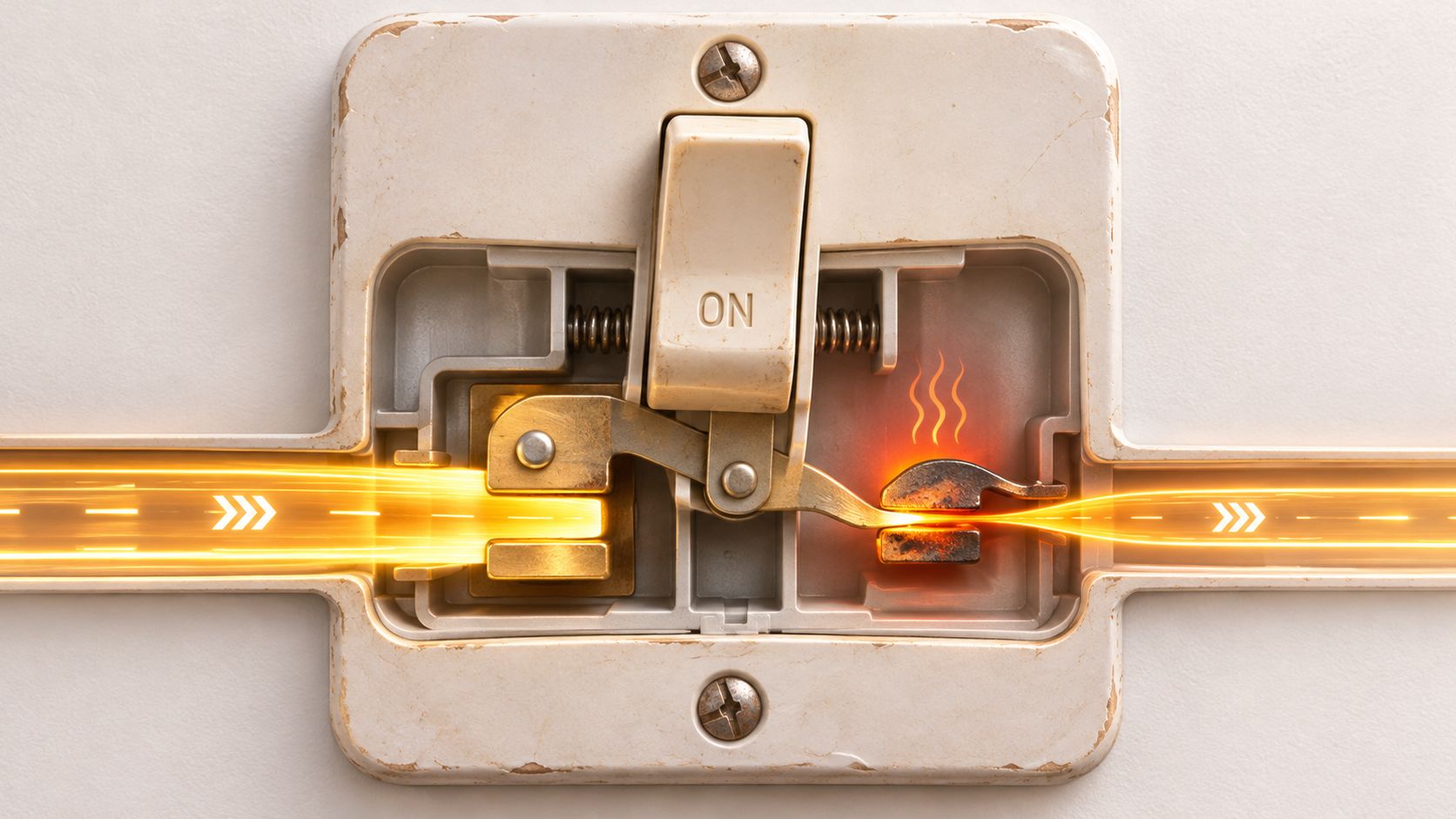
Why a small contact fault matters
When a worn contact separates, current can jump the gap. That's arcing, which produces localized heat and pits the metal surface. Further deterioration can make the connection increasingly unreliable and damage nearby insulation.
The broader hazard is substantial: the National Fire Protection Association reports that, from 2020 through 2024, U.S. local fire departments responded to an estimated annual average of 46,652 home structure fires in which electrical failure or malfunction contributed to ignition, or electrical distribution, lighting or power-transfer equipment was involved. That category extends well beyond switches, but it explains why electrical warning signs deserve attention.
A replacement switch won't correct an overheated splice farther inside the box, an undersized conductor or an overloaded circuit. The electrician needs to identify where the heat started and whether surrounding conductors remain usable.
A switch that still operates isn't necessarily safe. Heat at the plate is a wiring-safety signal, not a cosmetic defect.
What to Do When a Switch Gets Hot or Noisy
Heat, noise, discoloration or smell means the circuit needs attention now, not a trial replacement. Don't buy a new switch and assume installing it will make damaged wiring safe.
The U.S. Consumer Product Safety Commission's electrical safety guidance warns that a loose wire screw or worn switch can lead to arcing, overheating and fire. Your immediate job is to stop using the affected equipment, not expose the connection.
Make the area safe
Stop operating the switch. Don't flip it again to see whether the noise returns, because another successful operation won't establish that it's safe.
Turn off the circuit breaker if you can do so safely. Use the panel label to identify the circuit; switching the wall control off alone doesn't isolate all wiring in the box.
Leave the plate alone. Don't touch a hot or discolored cover, remove screws or pull the device forward to investigate.
Record what you noticed. Note the location, time, sound, odor and whether the light was on or off, without recreating the fault.
Keep the circuit off. Tell other household members not to reset the breaker or use the switch.
Call a qualified electrician. Describe any breaker trips and recent bulb, fixture or control changes so the inspection starts with useful information.
Leave if there's smoke, visible sparking or flame. Move away from the hazard and call emergency services rather than attempting electrical troubleshooting.
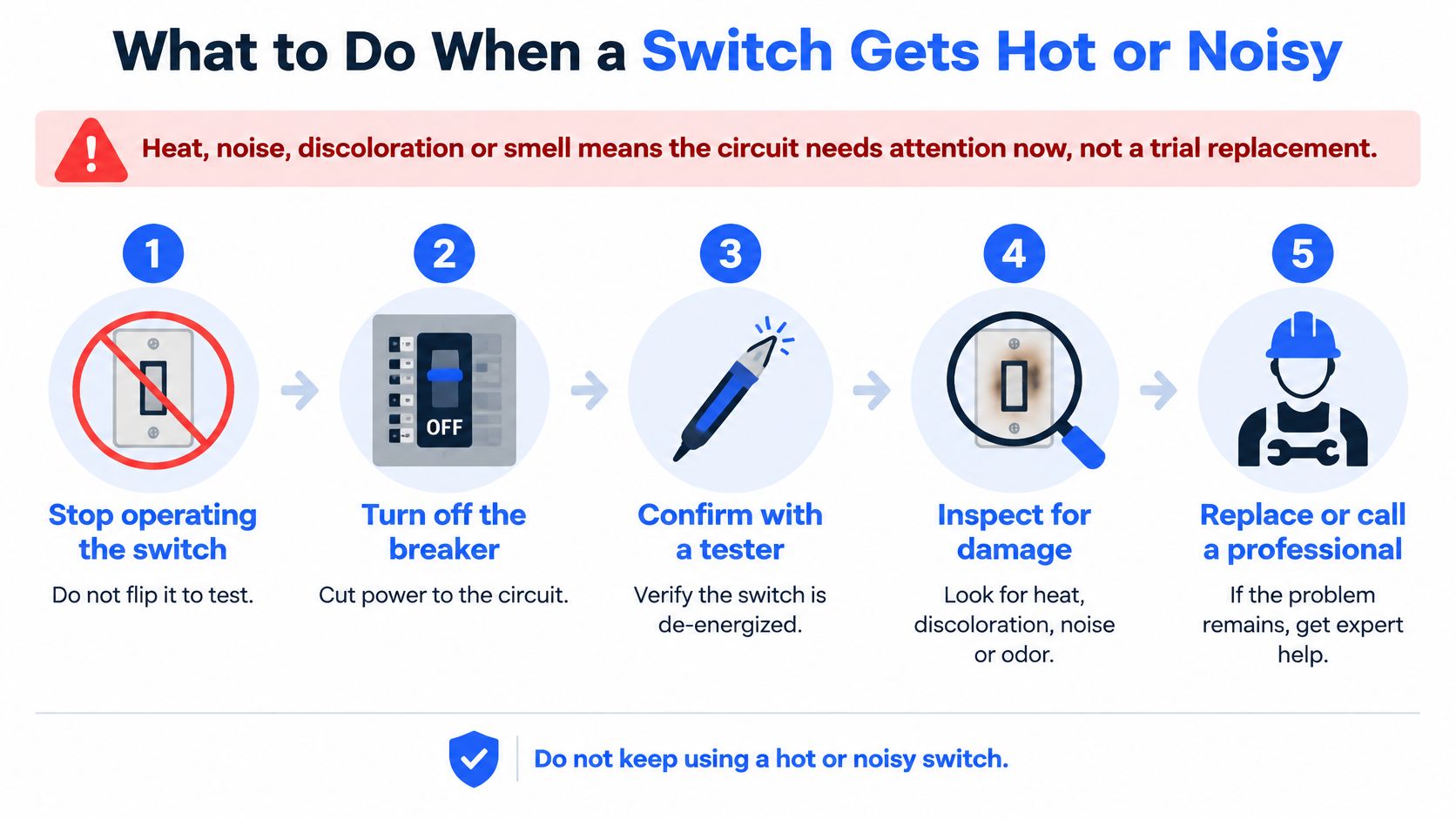
Leave testing and inspection to the electrician
For a hot or noisy switch, the tester and damage-inspection steps are professional work. Turning off a labeled breaker is a precaution, not proof that every conductor in the box is de-energized.
The electrician can verify isolation, examine terminals and splices, and check the connected load. Your notes help distinguish a fault tied to switch operation from one that persists elsewhere in the circuit.
A quiet switch after shutdown doesn't mean the problem has disappeared. The safe outcome is a circuit that stays off until a qualified electrician has identified the fault, completed necessary repairs and determined that power can be restored.
Testing a Switch Against a Circuit Fault
Diagnose by the pattern, not by opening the wall box. A homeowner can gather useful clues without removing the plate, but the same symptom can have several causes.
The Electrical Safety Foundation's electrical fire safety checklist identifies flickering, unusual electrical sounds, hot or discolored plates and repeated breaker trips as reasons for qualified inspection.
Read the pattern without recreating the fault
If only one light is out, begin with the replaceable bulb, provided there are no urgent warning signs. Turn the light off, let the bulb cool and install a known-good bulb of the correct type and rating. A failed bulb is easier to rule out than a failed switch; a dead integrated LED fixture needs a different assessment.
If the light responds only when the switch moves, the switch mechanism or its terminals becomes a stronger suspect. Record that behavior, but don't wiggle the toggle as a diagnostic test.
If flicker continues while the switch is untouched, consider the fixture connection, LED driver or dimmer compatibility. Timing matters: symptoms that began after a bulb change suggest a different starting point from symptoms following electrical work.
If several lights and outlets lose power together, check the breaker position first. That pattern points toward a shared supply problem rather than an isolated wall control.
If operating the switch trips the breaker, stop using it. A short circuit or ground fault is possible, but diagnosis is required; understanding ground faults versus short circuits doesn't make repeated resetting safe.
Keep the boundary clear: Observe what already happened. Don't deliberately reproduce an electrical fault.
You can also note which normally used outlets have lost power and whether symptoms occur with the light on or off. In older homes and remodeled rooms, undocumented wiring makes these clues less conclusive.
A non-contact voltage tester is a screening tool, not sufficient proof of safe isolation. Opening the box and testing terminals belongs with someone qualified to verify the instrument and every relevant conductor.
Dimmers, LEDs and Smart Switches That Mimic Failure
A recently installed control can misbehave without having worn out. Compatibility problems can resemble switch failure, especially when an LED upgrade changes the load on an existing dimmer.
Start with the labels and model numbers you can read without opening the box. The Electrical Safety Foundation's Switch to Safety guidance recommends compatible lighting controls, qualified installation and nationally recognized laboratory marks such as UL, Intertek or CSA.
Load or control | Common symptom | Compatibility check |
|---|---|---|
Standard incandescent or halogen | Usually straightforward switching when properly rated; flicker still needs investigation | Confirm the switch rating covers the bulb wattage |
Dimmable LED on a dimmer | Flicker or buzz at low settings | Check the dimmer against the bulb's compatibility list |
Non-dimmable LED on a dimmer | Flicker, dim glow or abnormal operation | Use a compatible dimmable bulb and dimmer, or a standard on/off switch |
Smart or wireless switch | Intermittent control or warm housing | Confirm load rating and neutral requirements; use a lab-listed model |
Three-way or multi-location circuit | Light works from only one location | Have an electrician verify traveler and common-terminal wiring |
Match the control to the actual load
Are the bulbs marked dimmable? A dimmer can't reliably turn a non-dimmable LED into a dimmable one. Even a dimmable bulb needs a compatible control, and a small LED load may fall outside the dimmer's operating range.
Did the problem begin after a smart-switch upgrade? Some controls require neutral wiring or particular companion devices. A wall box that accepted a mechanical switch won't necessarily support every electronic replacement.
Electronic controls also have genuine failure risks. The CPSC's wireless light-switch recall documents overheating and fire hazards, so checking the model and applicable recall information matters alongside load compatibility.
Does a multi-location light work only with the other switch in a particular position? Incorrect common or traveler connections are possible. Don't transfer conductors by physical screw position alone, because replacement devices may arrange terminals differently.
Some dimmers develop mild warmth during normal operation, but that's not permission to dismiss a hot plate, discoloration, crackling, buzzing or odor. Record the switch model, bulb type and upgrade date, then use our dimmer switch installation guidance to understand the installation considerations rather than experimenting with wiring.
Replace the Switch or Call an Electrician
A straightforward mechanical replacement and a heat-damaged connection are different jobs. The sensible decision depends on the condition of the circuit, the replacement's suitability and your ability to verify electrical safety.
I would treat switch replacement as the end of diagnosis, not the beginning. A new toggle that turns the light on doesn't establish that the conductors, splices and protection are sound.
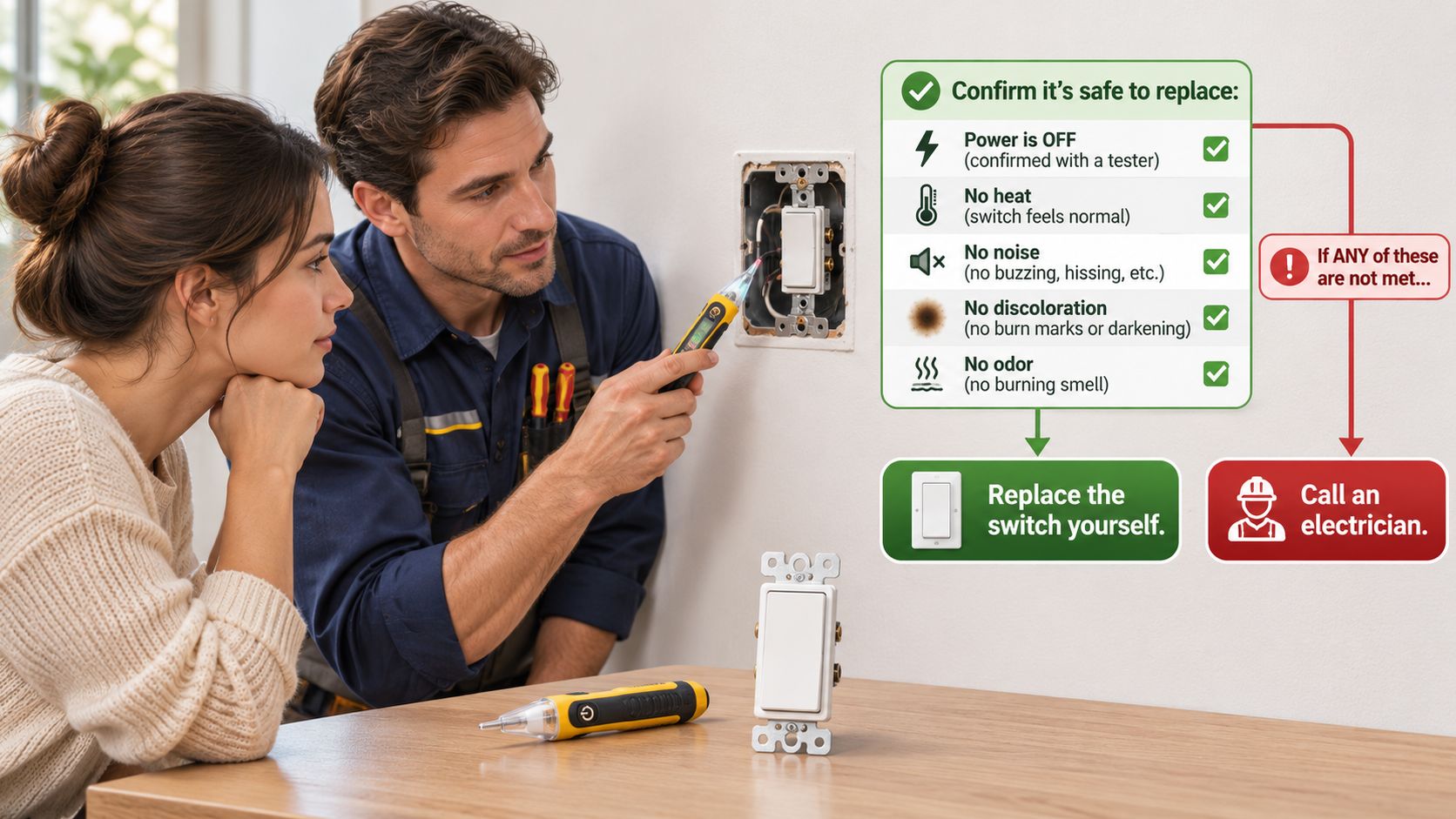
When a routine replacement may be reasonable
Consider doing the work yourself only if local requirements permit it and all these conditions are met:
Verified isolation: You know how to prove the circuit is de-energized with an appropriate tester, including checking that the tester works before and after testing.
No damage indicators: There's no heat, unusual noise, discoloration, odor or evidence of damaged insulation.
Correct replacement: The device matches the voltage, load type, current rating and single-pole, three-way or multi-location arrangement.
Established competence: You understand the wiring, grounding, terminal preparation and manufacturer's tightening requirements.
Being comfortable with a screwdriver isn't the same as being comfortable identifying conductors. If the wiring doesn't match what you expected, stop rather than improvising.
When professional diagnosis is the better choice
Call a licensed electrician rather than attempting a swap when any of these applies:
Safety symptoms: Heat, odor, discoloration, electrical noise or recurring breaker trips.
Uncertain wiring: Aluminum branch-circuit conductors, deteriorated older wiring or undocumented alterations.
Unclear controls: Traveler wiring you can't positively identify or a smart control whose wiring requirements aren't satisfied.
Wider effects: New loads cause lights to flicker across the home, suggesting a supply or capacity question beyond the switch.
Never install a higher-rated breaker to stop nuisance trips. The breaker must remain suitable for the conductors and equipment it protects.
When arranging help, give the dispatcher the symptoms before discussing an appointment. Ansa's resource on answering calls for electricians is aimed at contractors managing those calls; for homeowners, the useful takeaway is to lead with heat, odor or breaker trips so the urgency is clear.
A light switch can go bad, but a professional inspection determines whether the problem is the device, its connection or the circuit.
Our licensed electricians handle electrical troubleshooting and wiring repairs, along with dimmer installation and LED lighting upgrades. Write down the symptoms, switch and bulb types, and breaker location, then visit On Time Home Services to request an inspection. If the switch is hot, noisy or giving off an odor, leave the circuit off while you arrange help.
Comments