
AFCI vs GFCI Breaker: Which Protection Your Home Needs
The bathroom goes dark the moment you plug in a hair dryer, or the receptacle next to the kitchen sink has been dead since spring and you've been running the coffee maker off the dining room outlet. Either way you end up at the panel with a tripped breaker in your hand, then at the store shelf where two boxes look nearly identical and cost about the same. One says AFCI. The other says GFCI. Both fit the same slot.
That moment is the whole confusion in miniature. These are two different safety devices aimed at two different ways a circuit fails. An AFCI breaker watches for arcing that starts fires inside walls. A GFCI breaker watches for current leaking through a person. Neither does the other's job, and choosing wrong leaves you with a panel that looks updated and a circuit still exposed to the hazard that worried you in the first place.
Pick by hazard first, then by location, then by what your panel and your locally adopted code will accept. The grid below is the short version. After it comes a verdict for each circuit you're likely to be standing in front of.
Table of Contents
How Each Breaker Detects a Dangerous Fault - How a GFCI Watches for Leakage - How an AFCI Watches for Arcing
Where Code Requires AFCI and GFCI Protection - Reading the Location Table - A Three-Step Check Before You Order
Dual-Function AFCI/GFCI Breakers Explained - Where the Dual Device Falls Short
Nuisance Trips and Testing After Installation - The Reset Routine - Working Through the Cause
AFCI vs GFCI Breakers at a Glance
The direct answer is that an AFCI breaker and a GFCI breaker guard against different hazards, and one does not substitute for the other. NAHB's electrical code overview draws the line cleanly: a GFCI protects people from electric shock by detecting an imbalance between current flowing out on the energized conductor and current returning on the neutral, then disconnecting power when the leakage shows electricity may be passing through a person or another unintended path. An AFCI instead targets electrical arcing that overheats wiring and ignites surrounding building materials, which is why it protects branch-circuit conductors and cuts fire risk rather than shock risk.
AFCI vs GFCI breaker at a glance
Feature | AFCI breaker | GFCI breaker |
|---|---|---|
Primary hazard | Arc faults that overheat wiring and can ignite nearby materials | Shock from current leaking through a person or an unintended path |
What it senses | Arcing signatures on the circuit, including series and parallel arcs | Imbalance between current on the hot conductor and the neutral |
Trip point | When listed arc-detection criteria are met | Class A trips at 6 mA or higher and does not trip below 4 mA |
Main protection | Branch circuits, concealed wiring, cord and appliance faults | People at outlets, wet areas, outdoor and shock-prone locations |
Code origin | NEC 1999 edition, enforced for bedroom circuits from January 1, 2002 | NEC 1960s, first for swimming-pool lighting |
Two rows carry most of the weight. The trip-point row is where the devices stop being comparable at all, because one works inside a defined milliampere band and the other works on pattern recognition. The code-origin row explains the gap in real-world evidence you'll notice later: ground-fault protection has been in the National Electrical Code since the 1960s, initially for high-risk locations such as swimming-pool lighting, whereas the NEC first carried arc-fault requirements in its 1999 edition, with enforcement beginning January 1, 2002 for 15- and 20-ampere branch circuits supplying dwelling-unit bedrooms. The same overview notes that the National Fire Protection Association frames GFCIs around hazardous ground faults from defective appliances and corded equipment, and AFCIs around shutting off electricity when dangerous arcing conditions occur.
Treat this grid as generic characteristics, not the specification of any particular panel or breaker model. Breaker families differ in how they handle the neutral, what listing they carry for a given load center, and whether a two-pole version exists for shared-neutral circuits. What matters before you buy is which failure the circuit in front of you can produce.
Which Breaker Fits Each Circuit
Verdict first, reasoning second, so you can pattern-match to the circuit on your own panel.
Which breaker to consider by situation
Situation | Breaker to consider | Reason |
|---|---|---|
Replacing a failed breaker on a bathroom or kitchen circuit | GFCI breaker of matching amperage | Shock protection where water is present |
Bedroom or living-area circuit with arc concerns | AFCI breaker | Targets arc faults in concealed or aging wiring |
Circuit needs both protections and panel space is tight | Dual-function AFCI/GFCI breaker | Overlapping protection in one slot |
Circuit with damaged or defective wiring | Repair the wiring first, then choose the breaker | No breaker corrects defective conductors |
A bathroom or kitchen circuit is a shock story. Water, grounded metal, bare feet on tile, and a cord that gets yanked while your hand is near the sink. The failure you're defending against is current finding a path through a person, and that's the specific thing a GFCI measures. Matching the amperage to the existing breaker is the easy part. The harder part is confirming the replacement is listed for your panel's load center, because a breaker that physically snaps in but isn't listed for that enclosure is a code problem and sometimes a poor connection problem.
A bedroom or living-area circuit is a fire story. The wiring is concealed, the terminations sit behind drywall, and nobody looks at them for decades. Loose screws at receptacles, a conductor nicked by a nail during a remodel, brittle insulation at a fixture box. None of that draws enough current to trip a standard breaker, and all of it can arc. That's the case an AFCI is built for, and it's why the device shows up on sleeping and living rooms first in the code.
Field rule: match the device to the failure, not to the room name. If you can describe how the circuit would hurt someone, you want ground-fault protection. If you can describe how it would start a fire, you want arc protection.
Where both descriptions fit, say a laundry circuit or a kitchen small-appliance circuit, the honest answer is both functions, and a dual-function breaker is usually the cleanest way to get there. Where the wiring itself is damaged, a new breaker is a label on a problem. Fix the conductor first.
If you're planning a brand-new circuit rather than a swap, the process for adding a new circuit starts with a load calculation and a look at available panel space, not with the breaker. Our electricians are licensed and check the listing, the neutral arrangement, and the equipment grounding before anything goes into a panel.
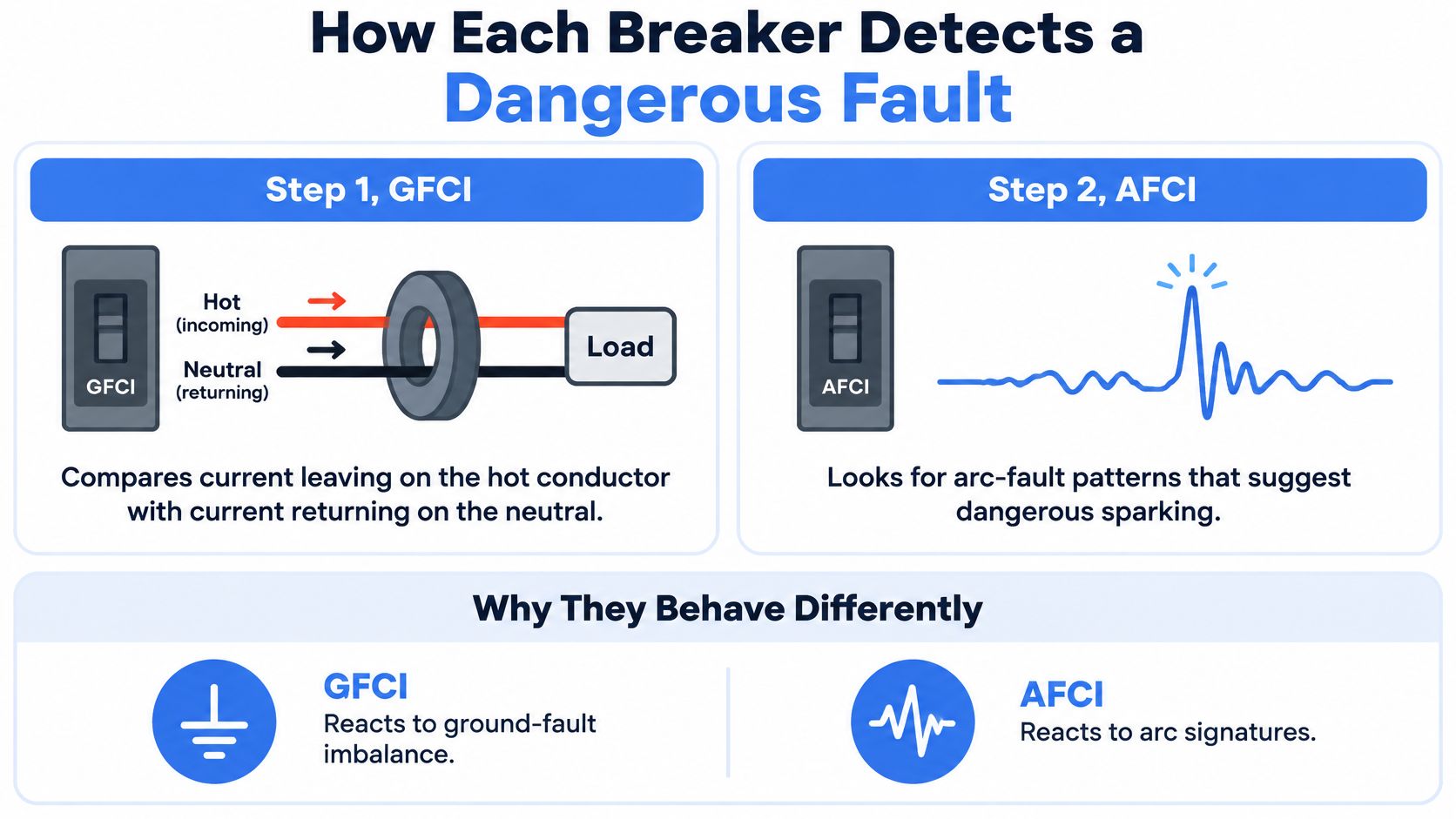
How Each Breaker Detects a Dangerous Fault
Each device watches for a different signature, so a fault that trips one will pass straight through the other. The NFPA code-panel document on arc-fault and ground-fault circuit protection treats them as separate failure mechanisms that shouldn't be swapped for each other.
The two detection paths, side by side:
How a GFCI Watches for Leakage
A GFCI compares the current leaving on the hot conductor with the current coming back on the neutral. On a healthy circuit those numbers match, because every electron that goes out has to come back. Any difference means current found another path to ground: through a person, a piece of grounded equipment, or a wet surface.
The Class A standard draws a hard window around that difference. The device must trip at 6 mA or higher and must not trip below 4 mA. The band is deliberate. It sits above the small leakage a healthy appliance produces and far below the current that can stop a heart, which is what makes a GFCI a personnel protector rather than just another overcurrent device.
How an AFCI Watches for Arcing
An AFCI monitors circuit current for the signatures of arcing: series arcs, where a single conductor has a break, and parallel arcs, where current jumps between conductors. When its listed detection criteria are met, it opens the circuit. The usual sources are damaged conductors, loose terminations, and cord or appliance faults, and the device exists to cut fire risk before an arc heats framing or insulation to ignition.
Two household failures separate the categories for good. A lamp cord nicked by a desk leg, tucked under a rug and arcing every time someone steps on it, is AFCI territory. The current stays normal; the heat does not. A hair dryer dropped into a full sink is GFCI territory. Current is now moving through water and a person to reach ground, and only the imbalance sensor reacts fast enough.
Combination AFCI/GFCI devices do both jobs, but the installation still has to satisfy the listing, the neutral arrangement, and the equipment grounding requirements. Residual-current device rules in other countries follow the same imbalance logic, and references like QLD safety switch compliance rules show how closely the overseas approach tracks the GFCI side of this discussion. If a tripped handle has you unsure whether the fault was leakage or a dead short, the difference between a ground fault and a short circuit is the distinction to get straight.
Once you know what each sensor measures, a tripped breaker stops being a nuisance and starts being a diagnosis.
Where Code Requires AFCI and GFCI Protection
Every line on the required list traces back to a fatal incident in that room, and the ground-fault rules are the oldest and broadest because they came first. A municipal electrical-safety history summarizing U.S. safety data puts the original stakes at more than 1,000 electrocutions nationwide in 1971, a figure that later fell below 400 as the NEC kept widening GFCI coverage. The same history reports that within 25 years of GFCI introduction, accidental electrocutions had dropped by more than half while electricity use had more than doubled.
The expansion arrived in dated steps. Pool-related protection began in the late 1960s. Requirements broadened to temporary wiring and water fountains in 1975, to hot tubs and spas in 1981, and to immersion-prone cord-and-plug appliances in 2002. Arc-fault protection came later and built up edition by edition, with the 2005 NEC adopting combination-type AFCIs effective January 1, 2008.
Reading the Location Table
I tell homeowners to filter by room first, because the room names the hazard. Wet and damp spaces point to shock. Habitable rooms point to arcing inside cords, junctions, and damaged conductors. Then confirm which NEC edition your jurisdiction enforces.
Where each protection is commonly required
Location | Usually required | Device type |
|---|---|---|
Bathroom receptacles | GFCI protection | GFCI |
Kitchen countertop receptacles | GFCI protection | GFCI |
Garages and unfinished basements | GFCI protection | GFCI |
Outdoor receptacles and wet locations | GFCI protection | GFCI |
Laundry areas | GFCI and AFCI under current editions | Dual-function or both device types |
Pool and spa areas | GFCI protection | GFCI |
Bedrooms | AFCI protection on 15- and 20-ampere branch circuits | AFCI |
Living areas and similar dwelling spaces | AFCI in most newer editions; check the adopted edition | AFCI or combination |
The exact list rides on the code edition your jurisdiction has adopted and on any local amendments. A panel in a city still enforcing an older edition can pass work that would fail one town over.
Two houses on the same street can be held to different code editions, because adoption happens locally. Get the edition question answered before you buy the breaker; inspection day is the wrong time to learn it.
A Three-Step Check Before You Order
Name the room and the hazard. Bathrooms, garages, outdoor receptacles, and anything within reach of water point to shock protection. Bedrooms and finished living space point to arc protection.
Match the room to the table. One row, one device type. Where a room lands on both lists, as laundry does under current editions, plan on a dual-function device or an AFCI breaker feeding a GFCI receptacle.
Confirm the adopted edition. A five-minute question to the local inspector or a licensed electrician costs less than a failed rough-in.
Bathroom circuits usually enter this conversation during a remodel, and remodel work that moves or adds receptacles typically needs a permit and a sign-off, so scope it with the inspector before walls open. For units where approvals run through the building as well as the city, permitted bath upgrades for co-ops is a useful read on how scope and approvals line up before trades start. And if the wiring behind those walls is old enough that its condition is an open question, a home electrical safety inspection tells you what you are working with before you spend money on devices.
Dual-Function AFCI/GFCI Breakers Explained
The simplest picture of a dual-function breaker is a single listed device that carries both sensing functions, which gives one circuit overlapping protection and uses one panel slot instead of two. In a house where the kitchen small-appliance circuit sits near a sink and the panel has no room left, that combination is often the difference between doing the job properly and leaving a cover off.
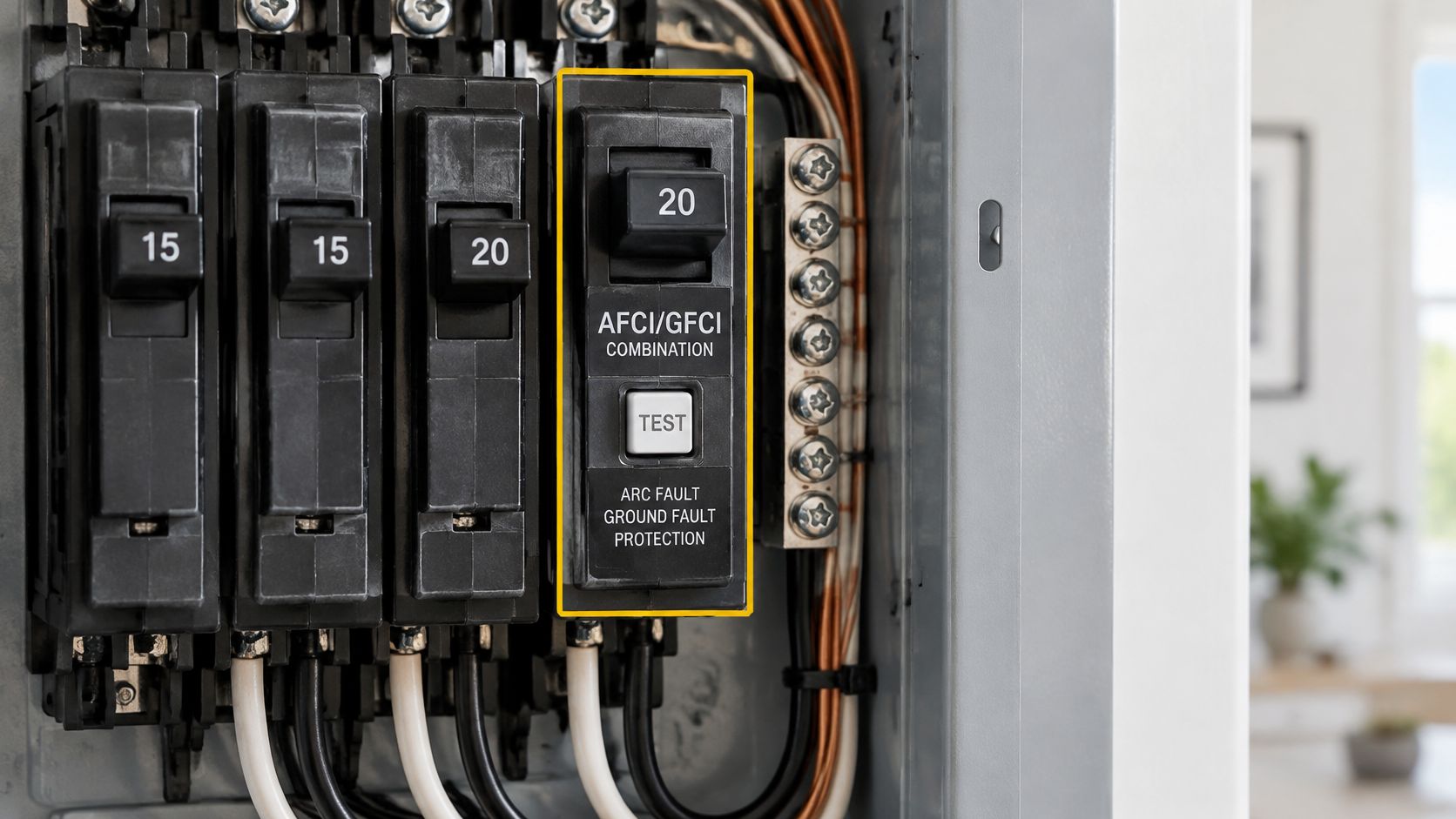
It earns its place in recognizable situations. A living-area receptacle circuit that needs arc protection but also feeds a spot with moisture exposure. A laundry circuit, which lands on both lists under current editions. A finished basement where the habitable rooms call for arc protection and the receptacles call for ground-fault protection, and one device covers the run without scattering GFCI receptacles through every box.
Where the Dual Device Falls Short
A dual-function breaker does not correct defective wiring. It does not remove the need for inspection and functional testing. It does not waive the neutral arrangement and equipment-grounding rules, and it won't fix a shared neutral that shouldn't be there. All it does is sense two failure modes instead of one.
The practical cost is diagnostic. With two sensing functions in one housing, a trip tells you something happened, not which function acted. On a single-function device the cause is half-diagnosed the moment you read the label. On a dual-function unit you're back to isolating loads and checking neutrals, which is fine for an electrician with a meter and frustrating for a homeowner with a flashlight.
On a circuit with one clear hazard, a single-function breaker gives you a faster answer the next time it trips. On a circuit with two hazards, the dual device saves the panel space and the second visit.
The decision rule is short. If the circuit needs both protections and the panel is tight, a dual-function breaker is the sensible buy. If only one hazard applies, take the matching single-function device and keep the trip cause readable. For a walkthrough of what trips these devices and how to test them, the video below covers the field side.
Nuisance Trips and Testing After Installation
A breaker that trips once did its job. One that trips every week is reporting a condition, and the report points at the circuit, the loads, or the wiring far more often than at the device itself.
The NFPA's home electrical safety guidance recommends testing AFCIs and GFCIs right after installation and monthly afterward, following the manufacturer's instructions for that specific device. Press the test button, confirm the breaker opens, reset it. Thirty seconds, and it catches a dead sensor before the sensor matters.
The two devices behave differently under that button. GFCI trip behavior is standardized through UL 943 Class A criteria: normal operation stays below the nuisance-trip region, and a ground fault at or above 6 mA must produce a trip. AFCI performance depends on the application, because arc signatures vary with load electronics, conductor geometry, installation quality, and the type of fault. That variability is exactly why a breaker tripping repeatedly should never be swapped for a less sensitive device. The trip is information.
The Reset Routine
Unplug or switch off everything on the circuit. Lamps, chargers, the space heater, the washer. Get the circuit as empty as you can.
Reset the breaker once. A single attempt, with no load plugged back in mid-reset.
If it trips again with nothing connected, leave it off. An active fault sits in the wiring or the device, and repeated resets do nothing except heat the panel.
Working Through the Cause
The order matters more than the meter. Start with shared neutrals, since two circuits on one neutral will trip both devices and look like a mystery. Then neutral-to-ground contact somewhere downstream, damaged insulation, loose terminations at a device or in the panel, moisture, incompatible equipment, and finally miswired line and load conductors on a replacement that never worked right from day one.
GFCI diagnosis hunts a path to ground: water, a damaged cord, a failing appliance, anything creating a leakage-current imbalance. AFCI diagnosis hunts an arc source or an appliance whose electronics mimic one, because the device reads abnormal high-frequency or intermittent current patterns. Same panel, different search.
Trip symptoms, likely causes and first checks
Symptom | Likely cause | First check |
|---|---|---|
Breaker trips soon after reset, even with few loads on | Shared neutral or neutral-to-ground contact downstream | Look for neutrals shared between circuits and any neutral touching ground |
AFCI trips when one appliance is plugged in | Arc signature from a damaged cord or appliance electronics | Unplug the appliance and inspect its cord |
GFCI trips at a bathroom or outdoor outlet in damp weather | Moisture or ground fault in a device or cord | Dry the area, unplug devices and reset once |
Trips with a heavy motor start or dimming lights | Loose terminations or overloaded circuit | Check tightness at the outlet or panel and the load rating |
Repeated trips with no visible fault | Miswired line and load, or incompatible equipment | Have a licensed electrician verify the wiring and the load |
Trips like these are among the more common reasons homeowners end up calling an electrician, and the table above shows why: one symptom can come from half a dozen different causes. Identify the cause first. A new breaker installed over an old fault trips the same way the old one did.
Frequent trips, flickering lights, or a house still running a 100-amp panel can point to capacity rather than a faulty device, and those situations call for a panel evaluation instead of another breaker. Breaker replacement is a real service and often the right fix, once the cause is known. Leaving the breaker off and bringing in a licensed electrician costs less than guessing twice.
Confirm Your Breaker Choice Before You Buy
Run this list before you order anything:
Identify the room and the hazard that circuit faces.
Read the existing breaker's label for amperage and brand.
Confirm the replacement is listed for your panel, not just that it fits.
Ask which code edition your jurisdiction has adopted.
Decide between a breaker and a GFCI outlet if only one receptacle needs shock protection.
Schedule a functional test after installation, then monthly.
That fifth item saves money more often than people expect. GFCI outlet installation protects a single location without touching the breaker, which suits a bathroom or kitchen receptacle that doesn't need a whole-circuit change. It's part of our electrical safety and outlet work, alongside subpanel and surge protection installation.
Repeated trips, a 100-amp panel, or any sign of damaged wiring are reasons to bring in a licensed electrician rather than work through breakers by trial. Have the details ready before the visit: the room served, the breaker label and amperage, the panel make, the age of the wiring, and any trip history. Those five answers turn a guessing game into a decision.
Match the device to the hazard, confirm the edition, then have it installed and tested.
If you're standing at the panel with a breaker in your hand and you'd rather not guess, On Time Home Services handles breaker replacement, GFCI outlet installation, and panel upgrades for homeowners across the Denver metro, with licensed electricians who confirm the listing and the adopted code before any device goes in. We'll also tell you plainly when the breaker isn't the problem and the wiring behind the wall is. Visit On Time Home Services to schedule a visit and get the circuit matched to the hazard it faces.
Comments