
When to Replace Electrical Panel: Signs and Next Steps
The short answer most homeowners need: replace the panel now if there's a burning smell, scorch or brown staining at the cover, a panel face that's warm to the touch, buzzing or crackling, or a breaker that trips again the second you reset it. Without those physical signs, a panel that's 40 or more years old, or one about to take on an EV charger, heat pump or electric range, calls for a licensed electrician's inspection and a documented load calculation before anyone quotes a replacement.
That's the situation you're probably in. Nothing has caught fire. Nothing is obviously broken. But the lights dip when the air conditioner starts, the kitchen breaker has tripped three times this month, and you're adding something big to the house this year. Now you're holding two conflicting pieces of advice: one neighbor says old panels are a fire waiting to happen, the other says nobody replaces a panel unless it fails.
Both are half right, which is exactly why the question of when to replace an electrical panel gets answered badly so often. Two different decisions hide behind the word "replace," and they get settled with different evidence.
Table of Contents
Warning Signs Your Panel May Need Replacement - Emergency signs to act on today - Signs that can wait for a scheduled visit
Capacity Problems Are Not Safety Problems - What a safety problem looks like - What a capacity problem looks like
How an Electrician Evaluates Your Panel - What a passing evaluation looks like
What Your Panel's Age Does and Does Not Tell You - Reading the era table - Where the 40-year mark comes from
EV Chargers, Heat Pumps and Other Loads That Change the Decision - The options, compared honestly - Two homes, two verdicts - Permits, utility coordination and the sequence
Schedule a Professional Evaluation Before You Replace Anything
When Replacement Is the Right Call
The oven is on, the dishwasher is running, and the kitchen breaker lets go for the third time this month. Or the lights dip every time the air conditioner kicks in and recover a second later. Neither moment tells you the panel has to go. Both tell you someone needs to open the cover and read what is happening inside it.
The split that matters is between two different jobs hiding behind the word "replace." A safety-driven replacement answers physical deterioration or defective design: heat damage at the cover, a burning smell, arcing sounds, or a breaker design with a documented failure history. That call is made on condition, and capacity math has nothing to do with it. A capacity upgrade answers a different question, whether the service can carry the load you are about to put on it, and that gets settled by a load calculation rather than the amperage printed on the main breaker.
So the replace now list stays short: signs of heat, burning or arcing, and defective design. Everything else lands in the inspect and calculate group. Repeated trips on one circuit belong there, since they usually trace back to an overloaded circuit or a weak breaker and often get solved by redistributing loads, adding a dedicated circuit, or replacing that one breaker. Rust, corrosion or water stains belong there too: the enclosure is degrading, and the moisture source has to be found and fixed before anyone can say whether the panel itself is salvageable. So does a panel that is 40 or more years old with no symptoms, and a healthy panel about to take on an EV charger, heat pump or electric range.
If you are weighing this against other equipment decisions on the same budget, the guidance on avoiding costly equipment failures applies to panels too: replace on condition and remaining service life rather than on a calendar alone.
The rule I come back to: age triggers an inspection, but condition and calculated load decide replacement.
Warning Signs Your Panel May Need Replacement
Warning sign | What it usually means | Urgency | Action |
|---|---|---|---|
Burning smell or scorch marks at the panel | Overheating connections or failing breaker | Emergency | Call an electrician or the utility immediately; keep clear of the panel |
Panel cover warm or hot to the touch | Overloaded circuit or failing breaker or bus bar | Emergency | Stop using affected circuits and get same-day service |
Buzzing, crackling or sizzling from the panel | Loose or arcing connections | Urgent | Professional inspection within days |
Breaker trips again instantly or will not reset | Short circuit, ground fault or failed breaker | Urgent | Leave it off and have the circuit diagnosed |
Repeated trips on the same circuit | Overloaded circuit or wiring undersized for the load | Soon | Redistribute loads, add a dedicated circuit or replace the breaker |
Lights flicker or dim when large appliances start | Voltage drop from loose connections or undersized service | Soon | Load calculation and panel evaluation |
Rust, corrosion or water stains on the panel | Moisture degrading enclosure, bus bars or terminations | Soon | Evaluate for replacement and fix the moisture source |
Fuse box or two-prong outlets in the home | Obsolete overcurrent protection and ungrounded circuits | Plan ahead | Upgrade evaluation before renovations or new appliances |
No spare breaker slots for new circuits | Panel at physical capacity | Plan ahead | Subpanel, listed tandem breakers or service upgrade |
Panel brand with known defective breaker designs | Breakers may fail to trip when needed | Urgent | Replacement typically recommended |
The table sorts by what a symptom does to your timeline, not by how dramatic it looks. A tripping breaker feels like an annoyance and often is one. A panel that smells like hot plastic is a different category of event, and the gap between those two can be a few minutes of arcing.
Emergency signs to act on today
Burning odor and scorch marks mean heat is being generated where metal should stay cool, usually at a loose termination or inside a breaker that's failing closed. A cover that's warm to the touch points to the same process, either an overloaded circuit dumping heat into the enclosure or a bus bar connection that's given up. Buzzing and crackling are the sound of arcing at a loose lug, and arcing is how panels start fires rather than just nuisance trips.
Signs that can wait for a scheduled visit
Repeated trips on one circuit usually mean that circuit is carrying more than its share, so the fix might be redistributing loads or adding a dedicated circuit rather than a panel. Flickering when the dryer or furnace starts is voltage drop, which points at loose connections or a service running near its limit. Rust and water stains tell you moisture has been sitting on bus bars and terminations, which is a replacement conversation more often than people expect.
Planned items are the quiet ones: a fuse box, two-prong outlets, no spare slots, or a 100-amp service in a home adding real load. Frequent trips, flickering lights, new appliances and an existing 100-amp panel are the four conditions that most often justify looking at an upgrade at all.
Don't pull the cover yourself. A photo of the open door with the breakers visible and a list of which circuits trip and when gives an electrician more than an hour of amateur disassembly. The stakes are why this matters: the National Fire Protection Association's home structure fire research estimated that U.S. fire departments responded each year to an average of 31,650 home fires involving electrical distribution or lighting equipment during 2019 to 2023, with about 430 civilian deaths and 1,280 nonfatal injuries annually, and wiring and outlets or receptacles involved in 42% of the deaths in that category.
Capacity Problems Are Not Safety Problems
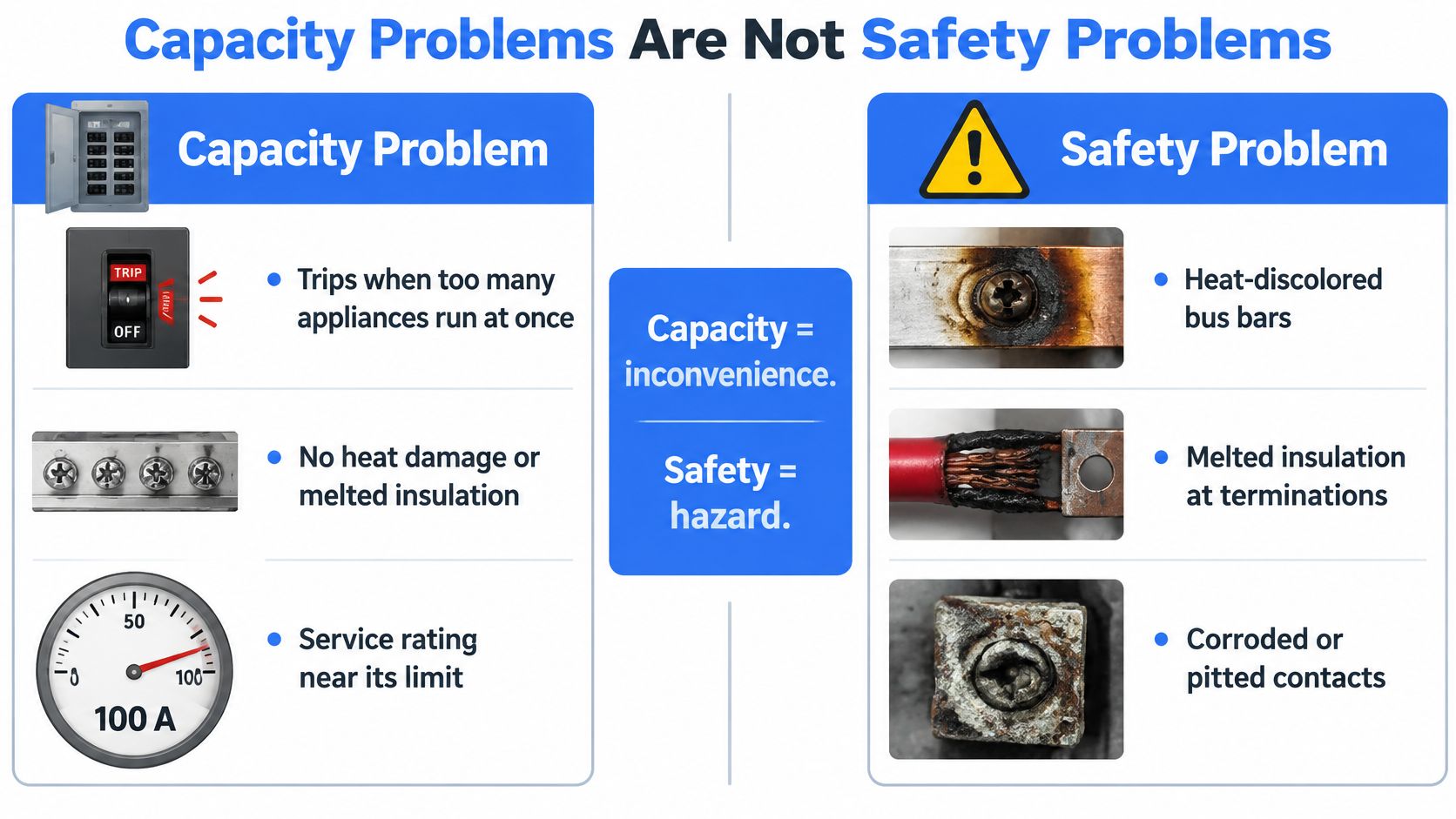
A 200-amp panel can be more dangerous than a 100-amp panel two streets over. Amperage is a rating, not a condition report. Confusing the two is how homeowners end up either keeping a hazardous panel because it's big, or paying to replace a healthy one because it's small.
What a safety problem looks like
Safety problems live inside the enclosure. Heat-discolored bus bars, melted insulation at terminations, corroded or pitted contacts, breakers that won't trip when tested, scorch marks on the deadfront, double-tapped lugs that were never listed for two conductors, or a panel with a documented defective breaker design. None of that is repaired by a bigger service or a load calculation. A spotless 200-amp panel with heat damage under the cover still needs component or full replacement.
What a capacity problem looks like
Capacity problems live in the arithmetic. The calculated demand of the house exceeds what the service and panel can deliver, or the panel has no slots left for another circuit. A 100-amp service with electric resistance heat, a tankless water heater and an EV charger is the classic case. So is a full panel with a finished basement and a hot tub on the wish list.
The dividing rule: a load calculation can prove or clear a capacity problem, but no calculation repairs physical deterioration.
Capacity problems often have cheaper answers than a new panel. A service upgrade with the existing panel retained, a subpanel fed from the main, listed tandem breakers where the panel is rated for them, or a load management device that sheds a large load when something else runs. Those options only exist if the panel itself is sound.
The U.S. Fire Administration's residential electrical fire data estimated 26,400 residential electrical-malfunction fires in 2024, causing 255 deaths, 800 injuries and $1.56 billion in losses, with fires up 5% and dollar losses up 25% across 2015 to 2024. Equipment condition drives those numbers far more than the size of the main breaker does.
When an electrician gives you a recommendation, ask one question: which problem did you find, safety or capacity? The answer decides whether you're repairing a hazard, buying headroom, or both.
How an Electrician Evaluates Your Panel
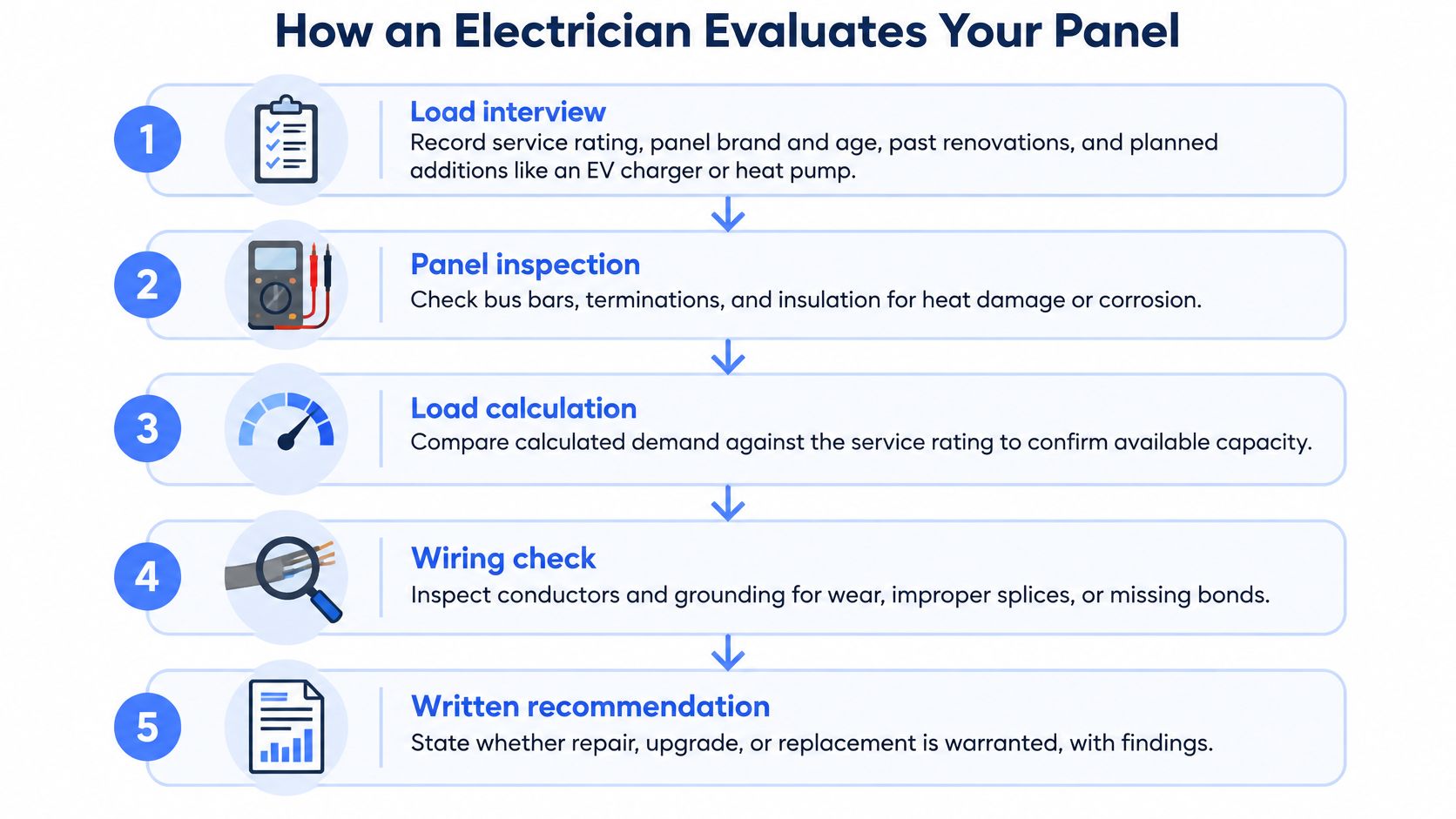
The evaluation isn't a look and a guess. It's a sequence, and each step exists to answer a question that changes the recommendation.
1. The load interview. Before any cover comes off, I want the service rating, panel brand and age, past renovations, and what's planned: an EV charger, a heat pump, a finished basement, a workshop. A homeowner who mentions a hot tub addition changes the whole recommendation, and that detail rarely appears in an email.
2. Exterior and nameplate check. Meter socket condition, service entrance conductor size, main breaker rating, and whether the panel falls into a brand with known breaker problems. A rusted-through meter base or a service mast pulled loose from the weatherhead gets flagged here too.
3. Interior inspection with power off where possible. Terminations checked for torque and heat, bus bars examined for pitting or discoloration, breakers seated properly on the bus, no double-tapped lugs, and breakers matched to the panel's listing rather than whatever fit at the hardware store.
4. Grounding and bonding verification. Ground rod or water pipe bond present and intact, neutral and ground separated correctly in a subpanel, bonding jumpers on the gas and water piping where required, and continuity confirmed with a meter rather than assumed from a glance.
5. Load calculation to code standards. Calculated demand compared against the service rating using actual square footage, fixed appliances, range, dryer, water heating, heating and cooling, plus planned loads. This step is what separates the two decisions: it can condemn a panel on capacity while the physical inspection clears it on safety, or the reverse. This walkthrough of load calculation for a home shows how the demand gets assembled instead of eyeballed.
6. Service and utility review. Whether the drop, meter socket or service conductors need upsizing, what the utility requires for a disconnect and reconnect, and what the permit and inspection sequence looks like before anyone schedules an outage.
7. A written verdict. Repair, component replacement, subpanel, load management, service upgrade or full replacement, with findings attached and a permit plan named.
What a passing evaluation looks like
Tight terminations with no heat discoloration, breakers that trip on test, a grounding and bonding system that checks out, and a calculated load comfortably under the service rating. That's a panel you keep, even if it's 45 years old.
What forces replacement is narrower than commonly assumed: heat-damaged bus bars, breakers that fail a trip test, an enclosure rotted by moisture, or a load calculation that still fails after load management is applied. If any of those are present, no clever workaround makes the panel safe.
The video below shows what this work looks like on a real panel.
Ask for a written scope with photos of what was found, not a one-line quote. A scope that names the service size after the work, the grounding method, the permit, and what happens to existing circuits is the difference between a bid and a plan.
What Your Panel's Age Does and Does Not Tell You
Age is a screening tool, and the U.S. Consumer Product Safety Commission home-wiring guide treats it that way. The guide identifies houses 40 years old or older as overdue for an electrical safety inspection, and recommends inspection for homes 10 to 40 years old when substantial electrical loads have been added, such as high-wattage appliances, additional lighting, receptacles, or heavy extension-cord use. It also notes that homes between 40 and 100 years old in its investigations had sometimes never been inspected since construction.
That second point is the one worth sitting with. Plenty of panels have never been evaluated by anyone since the day they were energized.
Reading the era table
Panel age or era | What you typically find | Recommended action |
|---|---|---|
Pre-1960 fuse box or 60-amp service | Ungrounded circuits, limited capacity, aged insulation | Evaluation; usually upgrade before major renovations or new loads |
1965 to 1973 aluminum branch wiring | Aluminum conductors prone to oxidation at connections | Inspection; remediate connections or devices as needed |
Brands with known defective breaker designs | Breakers that may fail to trip reliably | Replacement typically recommended |
1980s to 1990s panel in sound condition | Adequate breakers, but check terminations and capacity | Inspect when adding loads; repair or upgrade as findings require |
Any panel 40 years or older | Worn mechanisms, dated grounding, capacity limits | Schedule a safety inspection and load calculation now |
10 to 40 years old, adding major loads | Service may be undersized for EV chargers, heat pumps or ranges | Load calculation before the new appliance goes in |
The table is a starting point, not a verdict. A clean, tight, adequately sized 45-year-old panel can pass inspection without a single repair. A 25-year-old panel with corroded bus bars can fail on the same afternoon. Age gets you in the door; condition and capacity decide what happens next.
Where the 40-year mark comes from
The milestone exists because the consequences are measurable. The CPSC guide estimated approximately 46,000 fires annually involving home electrical distribution systems, causing about 440 deaths, 1,420 injuries and $1.15 billion in property losses in the data it cited. That's the risk being screened for, and it's why an inspection at 40 years is a reasonable habit even in a house that feels fine.
Practical habit: when buying a home, after a renovation, or before adding a large appliance, use the inspection to get a documented condition report. A report with photos tells you what you own. A guess based on the year the house was built doesn't.
EV Chargers, Heat Pumps and Other Loads That Change the Decision
The replacement question increasingly arrives with a new appliance attached: an EV charger, a heat pump, an induction range. A Level 2 home charger needs a dedicated 240-volt circuit, and a 100-amp service runs out of headroom fast once electric heating, water heating, cooking, drying or air conditioning stack on top of it. Do the arithmetic and the reason is obvious: a 48-amp charger at 240 volts pulls about 11.5 kilowatts, and it holds that draw for hours rather than minutes. On a 100-amp service, one charger can claim close to half of everything the house is allowed to pull before another appliance is even counted.
The options, compared honestly
Option | What it involves | Best when | Limits |
|---|---|---|---|
Load management or smart EV charger | Charger throttles charging to the capacity the house has free | Load calculation is close and the panel is in good condition | Needs a compatible charger; charging may slow at peak times |
Lower-power charging circuit | A dedicated 240-volt circuit at 32 to 40 amps instead of 48 | Overnight charging meets daily driving needs | Slower charging; still needs a dedicated 240-volt circuit |
Subpanel | New panel fed from the main to add circuit slots | Main panel is full but the service still has headroom | Adds breaker spaces only; total service capacity stays the same |
Service upgrade to 200 amps | New service entrance, meter socket, grounding and main panel | Load calculation fails or several large loads are planned | Higher cost, utility coordination, permit and inspection |
Full panel replacement in place | New panel and breakers at the same rating | Panel is corroded, heat-damaged or has defective breakers | Adds safety and slots but not service capacity |
The load calculation picks the branch. If the math passes and the panel is sound, a managed load or a lower-amperage circuit can still finish the charge by morning on the service you already have. If the math fails, the answer is capacity, and no charger setting will fix it. The rule I apply is simple: when the calculation passes and the panel is healthy, a replacement is a sale, not a solution.
Two homes, two verdicts
A Denver bungalow with a healthy 100-amp panel, gas heat, a gas range and a gas dryer adds one EV. A managed charger on a 32 to 40-amp circuit may satisfy the calculated demand with no panel replacement at all. The service stays, the charger gets installed, and charging slows for an hour on the coldest night of the year.
A 1950s home with a corroded 100-amp panel adds a heat pump, an induction range and an EV charger in the same year. That combination fails the calculation even with load management applied, and the corrosion rules out reusing the enclosure. Two triggers fire at once: the safety case for replacing damaged equipment and the capacity case for a larger service. That's a 200-amp service upgrade with a new panel, and it's the right call rather than an upsell.
If the remodel list also includes a heated bathroom floor, price it against the electrical work before committing, since the heated bathroom floor pricing breakdown is a load on the same service you're already evaluating.
Permits, utility coordination and the sequence
Any service upgrade runs through the utility, not around it. The contractor submits the service change and pulls the electrical permit, the utility disconnects and pulls the meter, the panel and grounding work happens while the wall is open, the inspector releases the job, and the utility reconnects. A well-run project fits that into one working day; a badly sequenced one leaves a house dark waiting on a truck.
If you're budgeting the charger side of the project, this breakdown of how much it costs to install EV charging at home covers the variables that move the number, including distance from the panel and whether the service needs work first.
Schedule a Professional Evaluation Before You Replace Anything
Three branches, and only three. If there's a burning smell, scorch marks, heat, buzzing or a breaker that won't reset, act now and treat it as an emergency. If nothing hurts but the panel is past 40 years or a heavy load is coming, book an inspection and a load calculation. Then let the written verdict choose between repair, subpanel, load management, service upgrade and full replacement.
Ask for four things in writing: the load calculation, photos of the terminations and bus bars, the permit where one is required, and a scope that names the service size after the work. Those four items are what separate a professional evaluation from a sales visit, and they're the cost drivers that decide whether the project is a component replacement or a service entrance rebuild.
In the Denver metro, our licensed electricians handle main panel replacements, 200-amp service upgrades, subpanels and EV charger circuits, with permits and inspections coordinated as part of the project. Book the evaluation before you buy any equipment. The verdict sets the scope, and the scope sets the price.
Panels rarely fail without warning. Flickers, trips, heat and buzzing are information. Treating them as information rather than annoyances is what keeps a small decision from turning into an emergency call at 9 p.m. A home electrical safety inspection is the cheapest version of that decision you'll ever buy.
If your panel is showing any of the signs in this guide, or you're about to add an EV charger, heat pump or electric range to a service that has never been calculated, On Time Home Services can evaluate it and tell you plainly whether you need a repair, a subpanel, a 200-amp upgrade or nothing at all. Our licensed electricians serve homeowners across the Denver metro with panel replacements, service upgrades and dedicated circuits, and we handle permits and inspections as part of the job. Visit On Time Home Services to schedule your evaluation and get a written scope before any work begins.
Comments